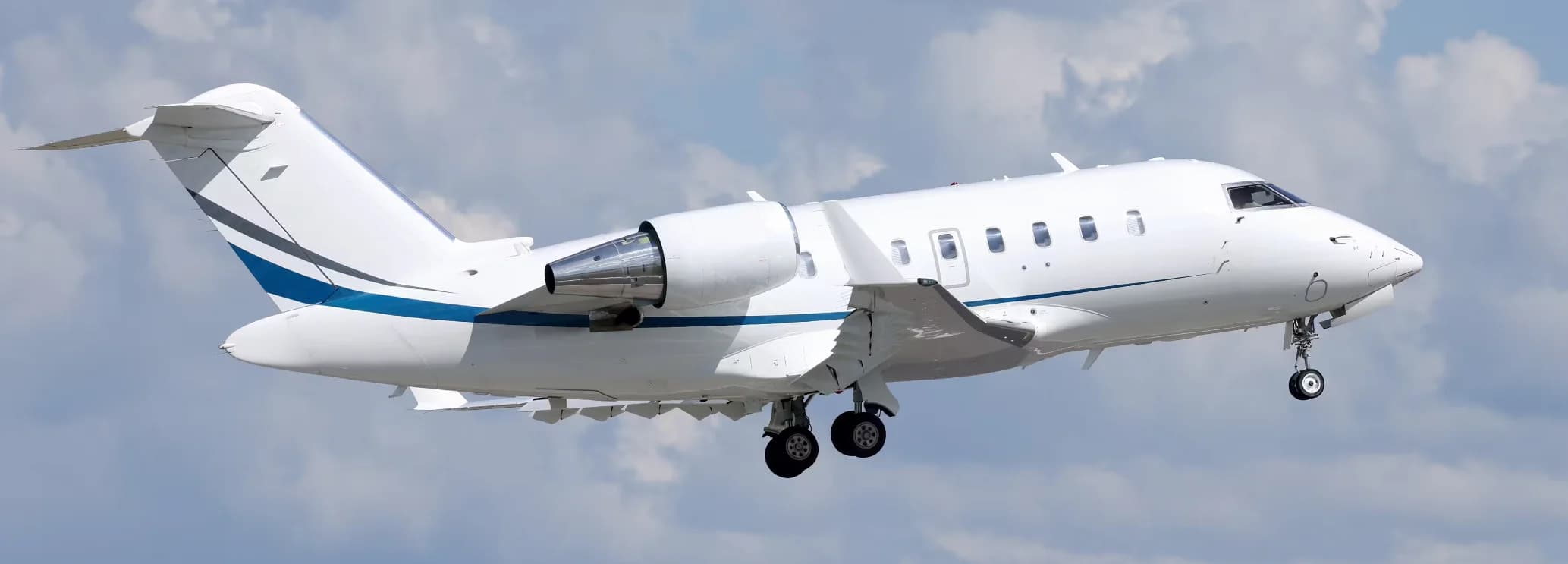
Best Air Charter a Bombardier Challenger 601

Challenger 601

Passengers

Range

Cruise Speed

Charter From

Best For

Up to 12

3,250 nm (3,740 mi)

459 ktas (528 mph)

$5,500/hr

Executive groups wanting Challenger 600 cabin space with updated GE engines and modern avionics

Note: The hourly rate is not the total trip cost. Final pricing includes landing and handling fees, crew, overflight permits, and taxes. Variable costs include repositioning, de-icing, wait time, and overnights. Contact Hogani Jets for an accurate all-in quote.

Charter of a Bombardier Challenger 601 starts at $5,500 to $8,000 per flight hour. Bombardier built the Challenger 601 primarily from 1987 to 1996, an upgraded successor to the Challenger 600. It seats up to 12 passengers across a 3,250-nautical-mile range at 459 knots. Twin General Electric CF34-3A engines produce 9,140 lbf each with a Rockwell Collins Pro Line 4 glass cockpit. The 28.3-foot cabin carries over the Challenger 600's wide-body cross-section. Hogani Jets coordinates each Challenger 601 charter through licensed Part 135 operators.

The Challenger 601 replaced the original Challenger 600 to fix its two biggest limitations: engine reliability and range. Bombardier, then operating as Canadair, swapped the 600's Lycoming ALF 502 engines for General Electric CF34 turbofans and added winglets to cut drag.

The first Challenger 601-1A flew on April 10, 1982, and earned FAA certification in March 1983. Later 601-3A and 601-3R variants added an EFIS glass cockpit and extended fuel capacity, pushing range past 4,000 nautical miles on the final 601-3R model.

Production of the Challenger 601 spanned three generations: the original 601-1A (1983-1987), the upgraded 601-3A (1987-1993), and the extended-range 601-3R (1989-1995). Bombardier replaced the line with the modernized Challenger 604 in 1995.

The Bombardier Challenger 601 is a heavy twin-engine jet built by Bombardier. Later production models carry up to 12 passengers across a 3,250-nautical-mile range at 459 knots. Two General Electric CF34-3A engines produce 9,140 lbf each, per specification data. Cabin length is 28.3 feet, unchanged from the original Challenger 600.

Specification

Bombardier Challenger 601

Manufacturer

Bombardier

Aircraft Category

Heavy jet

Passenger Capacity

Up to 12

Cabin Length

28.3 ft (8.63 m)

Cabin Width

8.2 ft (2.50 m)

Cabin Height

6.1 ft (1.86 m)

Cabin Pressurization

7,000 ft cabin altitude at cruise

Lavatory

Enclosed aft

Flight Attendant

Typically included

Baggage Capacity

115 cu ft

Max Range

3,250 nm (3,740 mi)

Max Cruise Speed

459 ktas (528 mph)

Service Ceiling

41,000 ft

Max Takeoff Weight

45,100 lbs

Typical Takeoff Distance

~5,400 ft

Typical Landing Distance

~4,600 ft

Engines

2 x General Electric CF34-3A

Avionics

Rockwell Collins Pro Line 4 (EFIS)

Hourly Charter Rate

$5,500 to $8,000

The original Challenger 600 had two real problems: unreliable Lycoming ALF 502 engines and limited range. Bombardier addressed both with the Challenger 601.

First, engineers replaced the ALF 502 turbofans with General Electric CF34 engines, delivering better thrust, fuel efficiency, and reliability. Early 601-1A models used CF34-1A engines producing 8,650 lbf each.

Second, Bombardier added wingtip winglets and a refined wing to reduce drag and improve range. The changes pushed range from the Challenger 600's roughly 3,386 nm to over 3,200 nm on early 601s, and past 4,000 nm on the final 601-3R.

Third, later 601-3A and 601-3R models added a Rockwell Collins Pro Line 4 EFIS glass cockpit, replacing the analog Honeywell and Sperry systems used on the original 601-1A and the Challenger 600.

Per published specifications, the 601-3R's GE CF34-3A engines produce 9,140 lbf each, and the aircraft reaches a service ceiling of 41,000 feet, 4,000 feet higher than the original 601-1A.

Bombardier delivered the Challenger 601 in three distinct generations between 1983 and 1995. The 601-1A came first, followed by the 601-3A with new engines and avionics, then the extended-range 601-3R.

Over 60 Challenger 601-1A aircraft were delivered between 1983 and 1987. The improved 601-3A followed in 1987 with CF34-3A engines and an EFIS cockpit, and the 601-3R arrived in 1989 with higher weights and range past 4,000 nautical miles.

Combined production across all three 601 variants totaled more than 250 aircraft through 1995, when Bombardier replaced the line with the modernized Challenger 604. Original new pricing ran approximately $13 to $16 million; pre-owned 601s today typically trade for $1.5 million to $3.5 million depending on variant, year, and avionics upgrades.

All three 601 variants share the same 28.3-foot, 8.2-foot-wide cabin cross-section introduced on the Challenger 600. The differences are almost entirely under the skin: engines, avionics, weights, and range.

A heavy jet trades a higher hourly rate for meaningfully more cabin room, passenger capacity, and comfort on longer flights.

  • More cabin: 28.3 feet long and 8.2 feet wide versus roughly 24 to 26 feet long and 6.5 to 7.7 feet wide for most super midsize jets.
  • More passengers: up to 12 versus 9 to 10 for most super midsize aircraft.
  • Full stand-up cabin height throughout, plus a forward galley and enclosed aft lavatory as standard.
  • Intercontinental missions: nonstop coast-to-coast US routes at full passenger loads, with select 601-3R variants capable of select transatlantic sectors.
  • Best mission: full-cabin corporate groups on transcontinental domestic routes and longer international trips.

The Challenger 601 seats up to 12 passengers. Standard configurations typically seat 8 to 10 in a forward club plus aft conference or divan layout.

  • A four-seat forward club section paired with a mid-cabin divan and an aft two-place club or additional divan zone.
  • An enclosed aft lavatory and forward galley are standard on nearly every configuration.
  • Cabin height is 6.1 feet; nearly all passengers can stand fully upright throughout the cabin.
  • Fold-away tables, overhead storage, and forward and aft wardrobes are common across most refurbished cabins.
  • Interior configurations vary widely by refurbishment date; many 601s in today's charter fleet have updated seating, lighting, and cabin management systems.
  • 115 cubic feet of baggage hold accommodates approximately 12 suitcases.

The Bombardier Challenger 601 cabin is 28.3 feet long, 8.2 feet wide, and 6.1 feet tall. Cabin pressurization holds a 7,000-foot equivalent altitude at cruise. The wide cross-section provides a genuine center aisle and full stand-up headroom. The aircraft seats up to 12 passengers with 115 cubic feet of baggage capacity.

Within the Challenger family, the 601 is the direct successor to the Challenger 600 with the same cabin and better engines. The Challenger 604 offers more range and modern avionics. The Challenger 601 offers a lower cost of entry with the same wide-body cabin.

The 3,250-nautical-mile range covers coast-to-coast US routes with reserves to spare. New York to Los Angeles (2,451 nm) is comfortably within nonstop range.

Route

ICAO Codes

Est. Flight Time

Notes

New York to Miami

KTEB to KMIA

~2h 15m

Well within nonstop range

Miami to Dallas

KMIA to KDAL

~2h 20m

Cross-country business corridor

New York to Los Angeles

KTEB to KVNY

~5h 05m

2,451 nm; comfortably within range

New York to Chicago

KTEB to KMDW

~1h 20m

Short hop showing the cabin's comfort advantage

The cost to charter a Bombardier Challenger 601 is typically $5,500 to $8,000 per flight hour. New York to Los Angeles one-way rental runs approximately $38,000 to $49,500. New York to Miami one-way charter price is approximately $22,000 to $29,000. Final all-in cost depends on operator, routing, positioning, and season. Fuel, crew, and maintenance are included in the hourly rate; landing fees, taxes, and repositioning are billed separately.

Contact Hogani Jets at charter@hoganijets.com or +1-855-660-0573 for a current quote.

Route

Est. One-Way Price

Notes

New York to Miami

$22,000 to $29,000+

Well within nonstop range

Miami to Dallas

$23,800 to $30,600+

Cross-country business corridor

New York to Los Angeles

$38,000 to $49,500+

Transcontinental nonstop

New York to Chicago

$23,300 to $30,600+

Short regional hop

The hourly rate covers core operational costs. Additional fees are quoted separately.

  • Aircraft operation: fuel, crew, and maintenance are included in the hourly rate.
  • Two certificated pilots: required for all operations.
  • Federal excise tax and segment fees: federally mandated, quoted separately.
  • Positioning costs: charged if the aircraft must reposition to your departure airport.
  • International handling fees: apply on Caribbean, Canada, and other international flights.

Contact Hogani Jets for current pricing and details.

The most natural comparisons are within the Challenger family and against contemporary heavy jets. The Challenger 600 offers the same cabin at a lower cost of entry. The Challenger 604 offers more range and modern avionics.

Specification

Challenger 600

Challenger 604

Challenger 601

Type

Heavy jet

Heavy jet

Heavy jet

Production

1980-1983

1996-2007

1987-1996

Passengers

Up to 12

Up to 12

Up to 12

Published Range

3,386 nm

4,115 nm

3,250 nm

Cruise Speed

459 ktas

459 ktas

459 ktas

Cabin Length

28.3 ft

28.3 ft

28.3 ft

Hourly Rate

$5,500 to $8,000

$5,500 to $8,000

$5,500 to $8,000

Best Use Case

Original Challenger platform; lowest cost of entry

More range; modern avionics; newer production

Updated GE engines and glass cockpit on the same proven cabin

Every Bombardier Challenger 601 charter coordinated by Hogani Jets is operated by an FAA Part 135 certificated direct air carrier holding full operational control of the flight. Each operator's certificate, insurance coverage, and safety record is independently reviewed before Hogani Jets coordinates a booking. ARGUS, Wyvern, or IS-BAO ratings are considered where they exist as one input to that review. Hogani Jets is an air charter broker and does not own or operate aircraft.

The Challenger 601 carries Rockwell Collins Pro Line 4 avionics on 601-3A and 601-3R models, with earlier 601-1As using analog Honeywell and Sperry systems. Twin General Electric CF34 engines power the type. GE Aerospace and Bombardier continue to provide parts and engineering support for the existing fleet.

The Challenger 601 suits full-cabin corporate groups on domestic transcontinental routes and regional business corridors. The following Hogani Jets route pages cover its most common corridors.

Relationship

Aircraft

When to Consider

Predecessor (Same Family)

Challenger 600

Lower cost of entry; same cabin; original Lycoming engines

Longer Range (Same Family)

Challenger 604

4,115 nm; modern avionics; newer production

Contemporary Competitor

Dassault Falcon 900

Trijet redundancy; higher 51,000 ft service ceiling; more passengers

Value Alternative (Super Midsize)

Bombardier Challenger 300

Lower hourly cost; smaller cabin; same manufacturer

Ready to book a Bombardier Challenger 601 charter or check availability? Contact Hogani Jets for a tailored quote. Call +1-855-660-0573 or email charter@hoganijets.com.

Reviewed by Matt Hogan — Founder, Hogani Jets & Aviation Specialist.

How much does it cost to charter a Bombardier Challenger 601?

Bombardier Challenger 601 charter rates typically run $5,500 to $8,000 per flight hour. New York to Los Angeles one-way runs approximately $38,000 to $49,500. Final cost depends on route, operator, positioning, and season.

What is the difference between the Challenger 601 and Challenger 600?

The Challenger 601 replaced the Challenger 600's Lycoming ALF 502 engines with General Electric CF34 turbofans and added winglets to reduce drag. Later 601-3A and 601-3R models also added a Rockwell Collins Pro Line 4 glass cockpit. Cabin dimensions stayed the same across both models.

How many passengers can the Bombardier Challenger 601 carry?

The Challenger 601 seats up to 12 passengers. Standard configurations typically run 8 to 10, in a forward club plus aft conference or divan layout.

How many Bombardier Challenger 601s were built?

Bombardier delivered more than 250 Challenger 601s across the 601-1A, 601-3A, and 601-3R variants between 1983 and 1995, before replacing the line with the Challenger 604.

What is the difference between the 601-1A, 601-3A, and 601-3R variants?

The 601-1A (1983-1987) used the original CF34-1A engines and analog avionics. The 601-3A (1987 onward) added CF34-3A engines and an EFIS glass cockpit. The 601-3R (1989-1995) added higher weights and extended range past 4,000 nautical miles.

What is the real range of a Bombardier Challenger 601?

Published range is 3,250 nautical miles for standard configurations. Later 601-3R variants with extended fuel tanks reached over 4,000 nautical miles. Realistic range with a full cabin runs somewhat lower depending on routing and reserves.

Are empty leg flights available on the Bombardier Challenger 601?

Yes. Repositioning flights create empty-leg opportunities. Availability is short-notice and date-fixed; Hogani Jets recommends flexibility when pursuing empty-leg pricing.

Is Hogani Jets a direct air carrier?

No. Hogani Jets is an air charter broker and does not own or operate aircraft. All Bombardier Challenger 601 charters are facilitated through licensed Part 135 direct air carriers holding full operational and regulatory control.

Last Updated: 23 Sep 2026, 01:08 PM

About Us

Hogani Jets was built on a simple belief: real luxury is quiet, personal, and effortless. We work with a curated list of operators and a small client base so we can give every journey the attention it deserves.

Instant Charter Estimate
compareairCraft1cloud
compareairCraft2cloud

Compare Aircraft

Compare private jet categories side by side, range, cabin, passenger capacity, and hourly cost to find the right aircraft for your mission and route.
https://d2fh6kg71io623.cloudfront.net/uploads/cms/1783689472835_cropped-image.webp

Your Guide: Hogani Jets Uncensored

Hogani Jets Uncensored: Submit your details for your free guide to private jet programs, honest truths, pricing and more.