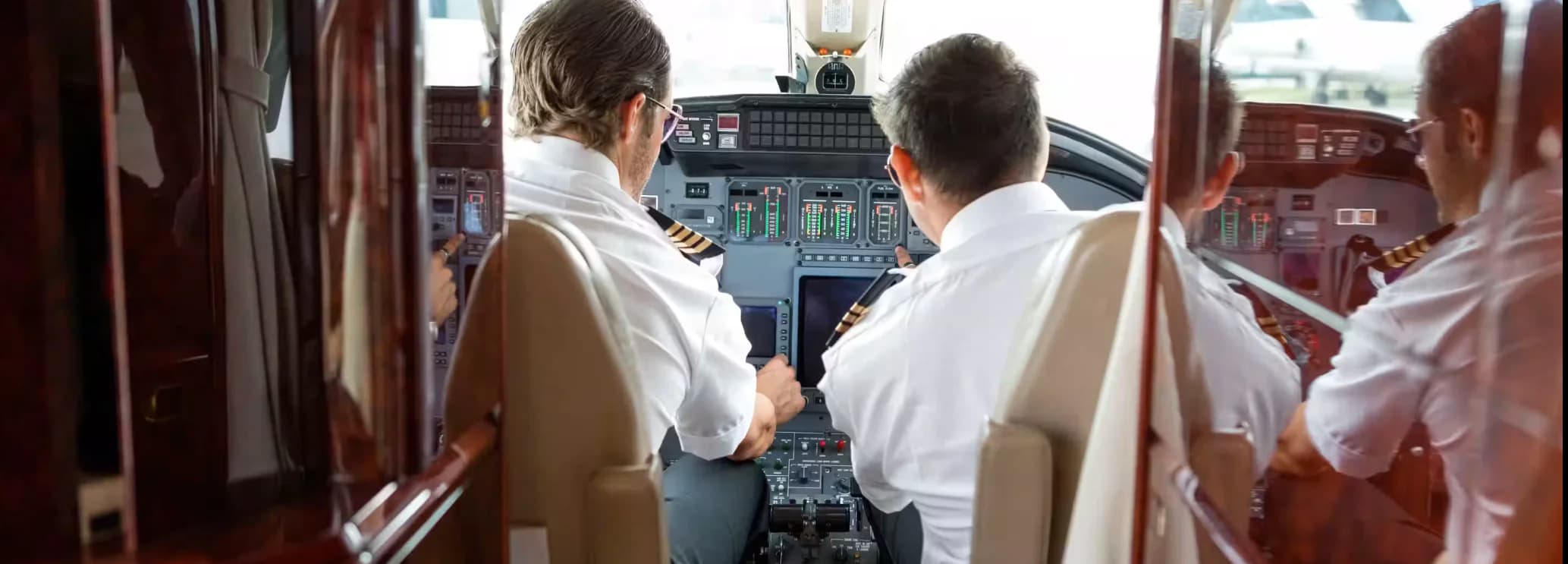
Private Jet Pilot Requirements- Who Flies Your Charter Flight
When you book a Part 135 charter flight, the pilots are employees or contractors of the FAA-certificated operator, not of the broker who arranged your trip. The operator's Part 135 certificate sets the minimum qualifications those pilots must hold. The operator's own standards, if they are serious about safety, exceed those minimums. Understanding both what the FAA requires and where quality operators set their internal bars gives you the framework to evaluate who is actually flying your aircraft.
Pilots operating charter flights under Part 135 must hold specific FAA certificates depending on the aircraft and role:
Commercial Pilot Certificate (CPL)
The minimum certificate required to act as pilot in command (PIC) on Part 135 operations in aircraft with fewer than 10 passenger seats. A commercial pilot certificate requires a minimum of 250 total flight hours and demonstrates the holder can operate an aircraft for compensation or hire. It is a higher standard than a private pilot certificate but below the airline transport pilot level.
Airline Transport Pilot Certificate (ATP)
Required to act as PIC on Part 135 aircraft with 10 or more passenger seats, and required for all PIC roles in Part 121 scheduled airline operations. The ATP is the highest level of FAA pilot certification. Standard ATP eligibility requires 1,500 total flight hours, including specific cross-country, night, and instrument hour thresholds, along with an ATP Certification Training Program (ATP-CTP) course and written and practical examinations.
For most private jet charter operations involving turbine aircraft with 10 or more seats, the PIC holds an ATP certificate. For aircraft with fewer than 10 seats, the PIC may hold a commercial certificate, though many quality operators require ATP for all PIC roles regardless of seat count.
Private jet pilots operating charter flights under FAA Part 135 must hold specific certificates depending on the aircraft and role. A commercial pilot certificate (CPL) with instrument rating is the minimum for PIC on Part 135 aircraft with fewer than 10 passenger seats. An airline transport pilot (ATP) certificate is required for PIC on aircraft with 10 or more seats. ATP eligibility requires 1,500 total flight hours plus specific cross-country, night, and instrument minimums, an ATP-CTP course, and FAA examinations. All pilots flying turbojet aircraft or aircraft above 12,500 pounds maximum takeoff weight must hold a type rating specific to that aircraft. Part 135 also requires recurrent training every 12 months and instrument proficiency checks every 6 months.
| Role | Minimum Total Hours | Cross-Country | Night | Instrument |
PIC (IFR operations) | 1,200 hours | 500 hours | 100 hours | 75 hours |
PIC (VFR operations) | 500 hours | 100 hours | 25 hours | N/A |
SIC (Second-in-Command) | Commercial certificate | Per CPL requirements | Per CPL requirements | Instrument rating required |
These are FAA regulatory minimums under 14 CFR Part 135. Quality operators set significantly higher internal minimums. It is not unusual for a reputable charter operator to require 3,000 or more total hours for PIC roles, with specific minimums in the aircraft type being flown.
A type rating is required for any aircraft above 12,500 pounds maximum takeoff weight, and for any turbojet-powered aircraft regardless of weight. This encompasses virtually every turbine-powered aircraft used in private jet charter, from light jets through ultra-long-range aircraft.
Obtaining a type rating requires completion of a training program specific to that aircraft type, including ground school, simulator training, and a checkride administered by an FAA examiner or authorized check airman.
A pilot who is type-rated on a Citation CJ3 is not automatically qualified to fly a Gulfstream G650; each aircraft type requires its own type rating.
When evaluating an operator or asking about crew qualifications, confirming that the pilot in command holds a valid type rating in the specific aircraft assigned to your flight is a basic but important verification.
Part 135 mandates ongoing training and proficiency checks that do not exist for private Part 91 operations. These requirements are part of what distinguishes charter operations from privately flown aircraft:
- Initial training: Comprehensive training on company operations, specific aircraft systems, emergency procedures, and crew resource management (CRM) before a pilot can serve in a Part 135 role
- Recurrent training: Required every 12 months, including simulator training and proficiency checks to verify ongoing competency
- Instrument proficiency checks: Required every 6 months under 14 CFR 135.297 to maintain instrument currency
- Line checks: Periodic evaluation of a pilot operating an actual revenue flight by a check airman
- Medical certificates: Part 135 PICs must hold at minimum a second-class FAA medical certificate, which requires a medical examination and includes more stringent standards than the third-class certificate required for private pilots
- Drug and alcohol testing: Part 135 operators must maintain FAA-compliant drug and alcohol testing programs covering all safety-sensitive employees including pilots
FAA Part 135 sets minimum pilot hour requirements that are floors, not industry standards. For IFR PIC operations, the regulatory minimum is 1,200 total flight hours including 500 cross-country, 100 night, and 75 instrument hours. Quality charter operators commonly require 3,000 or more total hours for PIC roles in turbine aircraft. ARGUS International and Wyvern safety audits include review of operator crew qualification records and training programs; ARGUS Platinum and Wyvern Wingman ratings provide third-party confirmation that an operator's crew standards have been independently reviewed. Confirming that the assigned PIC holds a current type rating in the specific aircraft assigned to a charter booking is a straightforward due diligence step.
The FAA establishes floors, not ceilings. Quality charter operators hold their crews to standards that meaningfully exceed those floors. When evaluating an operator, these are the differentiators:
Higher total hour minimums: Many quality operators require 3,000 or more total flight hours for PIC roles on turbine aircraft, compared to the 1,200-hour regulatory minimum for IFR operations. Some require specific turbine PIC time, not just total time.
Type-specific minimums: Beyond the type rating, quality operators set minimum hours in the specific aircraft type being flown. A pilot who received their type rating last month and a pilot with 1,000 hours in type are both type-rated; they are not equivalent, and good operators track the difference.
Crew resource management emphasis: CRM training is mandatory under Part 135, but the depth and recency of CRM training varies significantly between operators. High-quality operators treat CRM as a continuous practice, not a compliance checkbox.
ARGUS and Wyvern audits: ARGUS and Wyvern safety ratings involve review of the operator's pilot qualification records, training programs, and simulator visit schedules as part of the audit process. An ARGUS Platinum or Wyvern Wingman rating provides third-party confirmation that the operator's crew standards have been independently reviewed.
Hogani Jets works exclusively with ARGUS and Wyvern rated operators. As part of our booking process, we verify that the pilot in command assigned to your flight is type-rated in the specific aircraft, holds current medical certification, and is employed by or contracted to the Part 135 operator whose certificate governs the flight.
We do not verify individual pilot logbooks, but we rely on the operator's ARGUS or Wyvern rating as confirmation that their crew qualification standards have been independently audited.
If you have specific questions about crew qualifications for a booked flight, contact your Hogani Jets adviser before departure. A quality operator answers these questions directly.
Hogani Jets coordinates each charter through licensed Part 135 operators.
Contact Hogani Jets at charter@hoganijets.com or +1-855-660-0573.
What certificates do private jet pilots need?
Part 135 charter pilots need a commercial pilot certificate with instrument rating for aircraft under 10 seats, or an airline transport pilot certificate for 10 or more seats. Pilots flying turbine aircraft or aircraft above 12,500 pounds must also hold a type rating for that specific aircraft.
How many flight hours does a private jet pilot need?
FAA minimums for Part 135 IFR pilot in command require 1,200 total hours, including 500 cross-country, 100 night, and 75 instrument hours. Quality operators commonly require 3,000 or more hours for turbine PIC roles, significantly exceeding the regulatory floor.
What is a type rating for a private jet pilot?
A type rating is an FAA endorsement required for every turbojet aircraft and any aircraft above 12,500 pounds. It requires ground school, simulator training, and a checkride. A Citation CJ3 type rating does not qualify a pilot to fly a Gulfstream G650.
How often do private jet pilots have to retrain?
Part 135 requires recurrent simulator training and proficiency checks every 12 months, and instrument proficiency checks every 6 months. Medical certificates require renewal every 12 months for pilots under 40 and every 6 months for pilots 40 and over.
What is the difference between a commercial pilot and an airline transport pilot?
A commercial pilot certificate requires 250 total hours and permits flying for hire in certain operations. An airline transport pilot certificate requires 1,500 hours and is mandatory for PIC on Part 121 airlines and Part 135 aircraft with 10 or more passenger seats.
How do I know the pilots on my charter flight are qualified?
Check the operator's ARGUS or Wyvern safety rating, which includes independent audits of crew qualifications and training records. You can also request confirmation that the assigned PIC holds a current type rating in the specific aircraft and a valid FAA second-class medical.
What is a Part 135 pilot in command?
A Part 135 pilot in command is the FAA-designated person responsible for the safe operation of a charter flight. They must meet minimum hour requirements, hold the appropriate certificate and type rating for the aircraft, and maintain current medical certification and recurrent training.
What medical certificate does a private jet pilot need?
Part 135 pilots in command must hold at minimum an FAA second-class medical certificate. This requires a periodic medical examination: every 12 months for pilots under 40 and every 6 months for pilots 40 and over. First-class medicals are required for ATP certificate holders acting as PIC.
What is the ATP-CTP course for pilots?
The ATP Certification Training Program is a mandatory FAA course required before sitting the ATP written examination. It covers advanced aerodynamics, meteorology, air carrier operations, and leadership. The course must be completed at an FAA-approved Part 141 or Part 142 training provider before ATP certification.
Do private jet pilots need drug and alcohol testing?
Yes. Part 135 operators must maintain an FAA-mandated drug and alcohol testing program covering all safety-sensitive employees including pilots. Testing includes pre-employment, random, post-accident, reasonable suspicion, and return-to-duty testing. Operators without a compliant testing program cannot hold a valid Part 135 certificate.
Last Updated: 14 Sep 2026, 12:36 PM
About Us
Hogani Jets was built on a simple belief: real luxury is quiet, personal, and effortless. We work with a curated list of operators and a small client base so we can give every journey the attention it deserves.
Instant Charter Estimate

Compare Aircraft
Compare private jet categories side by side, range, cabin, passenger capacity, and hourly cost to find the right aircraft for your mission and route.
Your Guide: Hogani Jets Uncensored
Hogani Jets Uncensored: Submit your details for your free guide to private jet programs, honest truths, pricing and more.
