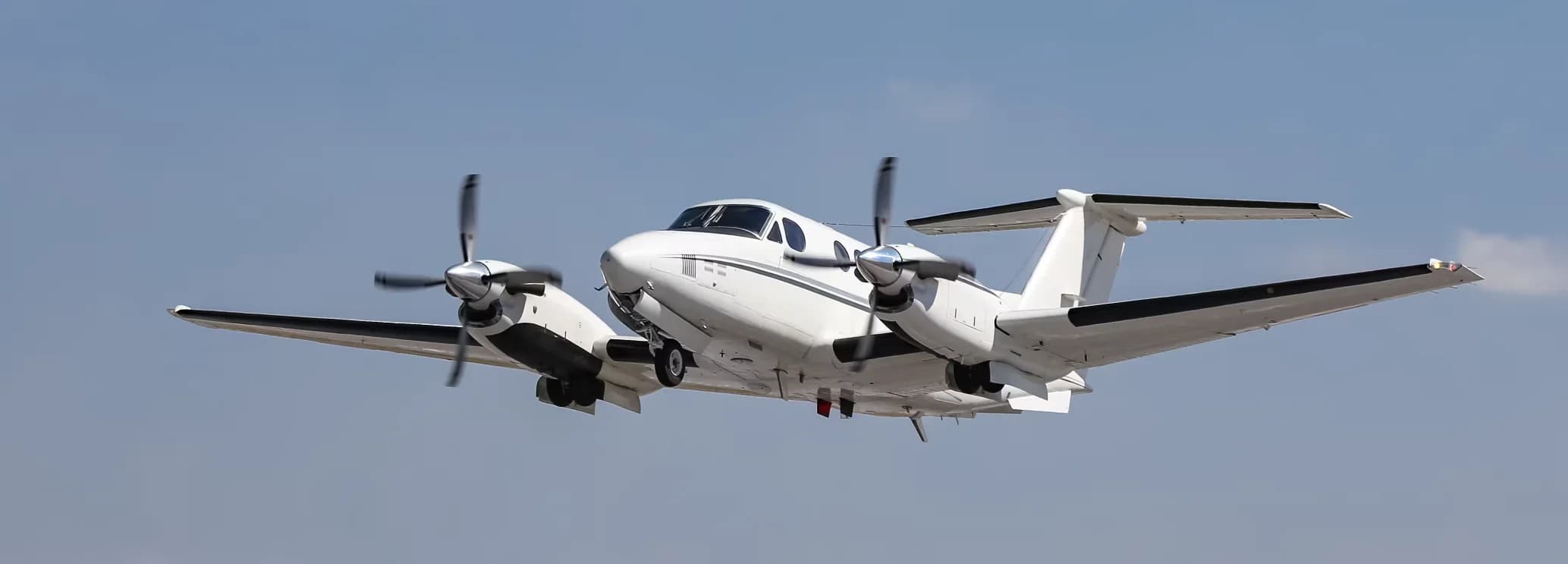
Turboprop vs Light Jet: Which Aircraft Fits Your Route?
A turboprop uses a gas turbine engine to drive a propeller. A light jet uses turbofan engines that produce thrust through jet exhaust. The practical differences are speed, cruise altitude, airport access, and cost. Turboprops cruise at 250 to 340 knots at up to 30,000 feet. Light jets cruise at 400 to 460 knots at up to 45,000 feet. On routes under 500 nautical miles, the speed gap narrows to under 30 minutes door-to-door. On longer routes, the light jet advantage compounds into hours recovered, not minutes.
A turboprop is powered by a gas turbine engine. That engine does not produce thrust directly. It drives a propeller through a reduction gearbox, and the propeller generates thrust. The result is an aircraft that combines the reliability of a jet engine with the efficiency of a propeller at lower altitudes and speeds.
Turboprops are pressurized, fly on instrument flight rules, and operate under the same FAA Part 135 certification standards as jets when used for charter. The safety standards, pilot qualification requirements, and maintenance programs are equivalent.
The cabin experience in a modern turboprop executive configuration is closer to a light jet than most travelers expect. Enclosed lavatories, leather seating, and full baggage storage are standard on leading models. The main perceptible differences from a jet are the propeller sound at low altitude and the slightly longer taxi to cruise altitude.
The Pilatus PC-12 NGX is the most widely used single-engine turboprop in private charter globally. Powered by a Pratt & Whitney PT6E-67XP engine producing 1,200 shaft horsepower, it cruises at 285 to 290 knots and delivers 1,765 to 1,803 nautical miles of range. The cabin is 16.9 feet long, 5 feet wide, and 4.83 feet tall, with 356 cubic feet of volume. Minimum takeoff field length is 2,450 feet. The aircraft seats 6 to 9 passengers in an executive configuration. The 2025 PC-12 PRO update introduced the Garmin G3000 Prime integrated flight deck with Emergency Autoland, the first single-engine turboprop to carry this system. Charter rate: $1,300 to $1,900 per hour.
The Beechcraft King Air 350 is the most popular twin-engine turboprop for private charter. Powered by twin Pratt & Whitney PT6A-60A engines of 1,050 shaft horsepower each, it cruises at 312 knots and delivers 1,806 nautical miles of range. The cabin seats 8 passengers with 17 feet of cabin length and a 57.8-inch width. The 350 is certified to 35,000 feet, meaningfully higher than the PC-12. The twin-engine configuration provides operational flexibility in regions where single-engine commercial operations face restrictions. Charter rate: $1,600 to $2,200 per hour.
The Beechcraft King Air 360 is the mid-tier twin turboprop, offering 1,720 nautical miles of range with seating for 6 to 9 passengers. It shares the King Air family's reliability record and is widely available across the US and Europe. Charter rate: $1,600 to $2,200 per hour.
The Daher TBM 960 is the fastest single-engine turboprop in production, cruising at 330 knots at 31,000 feet. It seats 4 to 5 passengers and covers up to 1,730 nautical miles. The TBM 960 targets the niche where a client wants turboprop economy with speed approaching light jet performance. Charter rate: $1,500 to $2,000 per hour.
Turboprops cost 30 to 50 percent less per hour to charter than comparable light jets. The Pilatus PC-12 NGX charters at $1,300 to $1,900 per hour in 2026 and requires a minimum field length of 2,450 feet, giving it access to more than 7,000 airports light jets cannot use. The Beechcraft King Air 350 delivers 1,806 nautical miles at 312 knots from a twin-engine platform certifiable to 35,000 feet. On routes under 500 nautical miles, the speed advantage of a light jet adds only 10 to 30 minutes of travel time compared to a turboprop.
A light jet uses turbofan engines to produce thrust directly through jet exhaust. This engine type enables higher cruise speeds, higher service ceilings, and better performance in the cruise regime above 35,000 feet where turboprops do not operate.
Light jets are the entry point for a consistent private jet experience. Enclosed lavatories with doors, club seating for 6 to 8 passengers, pressurized baggage compartments, and cabin altitudes equivalent to or better than commercial aircraft are standard. The interior quality gap between a modern light jet and a turboprop is narrowing, but at cruise altitude in smooth air above weather, the difference in comfort and speed is clear.
Light jets are certified for single-pilot operation on most models, which affects availability and scheduling flexibility. A single-pilot requirement means the aircraft can be positioned with lower crew cost than multi-crew jets.
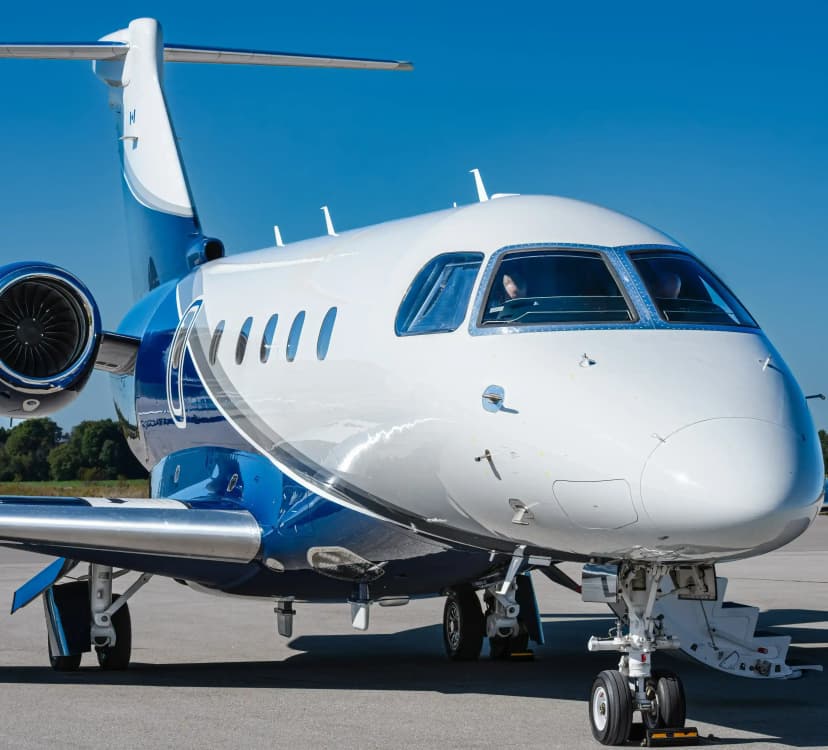
The Embraer Phenom 300E is the best-selling light jet in the world for multiple consecutive years, with 921 aircraft delivered as of Q1 2026. It cruises at 453 knots and delivers approximately 1,971 nautical miles of range. The cabin seats 6 to 7 passengers with a fully enclosed private lavatory at the rear. It holds the record as the fastest single-pilot certified jet available for charter. Charter rate: $2,800 to $3,800 per hour.
The Cessna Citation CJ4 delivers 2,165 nautical miles of range at 451 knots cruise speed. The cabin seats 7 passengers. The CJ4 is particularly popular for US domestic routes where its range and speed allow it to complete most transcontinental segments with one fuel stop. Charter rate: $2,500 to $3,500 per hour.
The Cessna Citation CJ3+ seats 7 passengers and delivers 2,040 nautical miles of range at 416 knots. It is one of the most cost-efficient light jets for domestic routes under 1,500 nautical miles. Its smaller cabin is appropriate for groups of 4 to 6 passengers who prioritize cost efficiency over cabin width. Charter rate: $2,500 to $3,500 per hour.
The HondaJet Elite II is notable for its over-the-wing engine mount design, which frees the rear cabin from engine noise and vibration. It seats 5 to 6 passengers and delivers 1,437 nautical miles of range at 422 knots. It is well suited to shorter domestic routes. Charter rate: $2,200 to $2,800 per hour.
Light jets cruise at 400 to 460 knots at altitudes of 41,000 to 45,000 feet, above most convective weather systems that turboprops must route around at 25,000 to 31,000 feet. The Embraer Phenom 300E, the world's best-selling light jet with 921 deliveries as of Q1 2026, cruises at 453 knots and delivers 1,971 nautical miles. On routes exceeding 1,000 nautical miles, the light jet arrives 35 to 90 minutes faster than a turboprop on the same sector. Charter rates run $2,500 to $3,500 per hour in 2026.
Specification | Turboprop | Light Jet |
|---|---|---|
Engine type | Gas turbine driving propeller | Turbofan jet engines |
Cruise speed | 250 to 340 knots | 400 to 460 knots |
Max cruise altitude | 25,000 to 31,000 feet | 41,000 to 45,000 feet |
Range | 1,000 to 1,800 nm | 1,400 to 2,500 nm |
Min runway required | 2,450 to 3,200 feet | 3,500 to 4,500 feet |
Airport access | 7,000+ airports | Fewer, longer runways required |
Passengers (typical) | 6 to 9 | 6 to 8 |
Lavatory | Varies by aircraft | Enclosed, private on most models |
Weather routing | Must route around most systems | Above most convective weather |
Annual ownership cost (300 hrs) | $537,000 to $900,000 | $1,100,000 to $1,600,000 |
Charter rate (2026) | $1,100 to $1,900/hr | $2,500 to $3,500/hr |
Best for | Under 500 nm, short runways | Over 800 nm, speed-critical travel |
The headline speed difference between a turboprop and a light jet is 100 to 150 knots. In cruise, that is meaningful. In door-to-door travel time, the picture is more nuanced.
On a 300-nautical-mile sector, total flight time in a King Air 350 is approximately 70 minutes. In a Phenom 300E, approximately 45 minutes. The 25-minute difference is real, but at a 30 to 50 percent lower charter cost, most operators and clients consider the turboprop the rational choice on short regional routes.
On a 1,000-nautical-mile sector, the comparison changes. A King Air 350 takes approximately 3 hours 20 minutes. A Phenom 300E takes approximately 2 hours 20 minutes. One hour recovered matters differently than 25 minutes. For a business traveler with a meeting on arrival, the light jet now earns its premium.
Above 1,500 nautical miles, the turboprop is rarely the right choice on a speed basis. The King Air 350 takes approximately five hours on a 1,500-mile route. The Phenom 300E takes approximately three hours and twenty minutes. A 100-minute difference on a single trip is a material productivity and fatigue variable.
On a 300-nautical-mile sector, a Beechcraft King Air 350 arrives approximately 25 minutes later than an Embraer Phenom 300E. On a 1,000-nautical-mile sector, the gap widens to approximately 60 minutes. On a 1,500-nautical-mile sector, the light jet advantage reaches approximately 100 minutes. The annual operating cost difference between a PC-12 and a Phenom 300E at 300 hours of usage is approximately $240,000 to $300,000. Below 500 nautical miles, cost efficiency favours the turboprop. Above 800 nautical miles, the time savings of the light jet typically justify the higher hourly rate.
Turboprops are certified to 30,000 to 35,000 feet, depending on the model. In practice, most turboprops cruise at 25,000 to 28,000 feet. At those altitudes, significant weather systems are present. Turboprops must route around convective activity, adding time and occasionally diverting.
Light jets cruise at 41,000 to 45,000 feet. At those altitudes, the aircraft is above most convective weather systems in North America and Europe. The ride is smoother. Routing deviations are less frequent. On weather-heavy routes or in summer months when afternoon convection is common, the light jet advantage is not just speed. It is a qualitatively different flight experience.
For routes where weather is a regular operational factor, the altitude difference between categories is a genuine selection criterion, not a secondary consideration.
The Pilatus PC-12 NGX requires a balanced field length of 2,450 feet. The King Air 350 requires approximately 3,300 feet. Most light jets require 3,500 to 4,500 feet at sea level, with longer requirements at altitude or in hot-and-high conditions.
This is not a minor operational difference. More than 7,000 airports in the United States have runways shorter than 4,000 feet. Many island destinations in the Caribbean and Pacific, mountain airports in Colorado and Alaska, and remote airstrips in Canada and Mexico fall into this category. A turboprop can land where a light jet cannot.
For operators serving agricultural businesses, mine sites, remote lodges, island resorts, or any destination where the infrastructure limits aircraft size, the turboprop is not the compromise choice. It is the only choice. The Pilatus PC-12 is widely used by corporate flight departments, air ambulance operators, and bush operations globally for exactly this reason.
The charter rate difference between a turboprop and a light jet is visible and significant. The ownership cost difference is even larger.
The total annual operating cost of a Pilatus PC-12 NGX is approximately $745,600 at 300 flight hours per year. Fixed costs run approximately $400,000 annually, while variable operating costs including fuel, maintenance, and engine reserves average approximately $1,152 per flight hour.
A Phenom 300E at equivalent utilization runs approximately $1,300,000 to $1,500,000 per year in total ownership cost. The gap of approximately $600,000 per year is the financial argument for the turboprop at high utilization in markets where it can serve the route profile.
For charter clients, this ownership cost structure flows through to the quoted charter rate. The turboprop is genuinely less expensive to operate, and the saving is passed through in the hourly rate.
Choose a turboprop when the route is under 500 nautical miles, when the destination airport has runways shorter than 4,000 feet, or when cost efficiency is the primary variable. A turboprop delivers the private terminal experience, dedicated crew, and point-to-point routing that defines private aviation, at 30 to 50 percent lower cost than a light jet on the right route.
The turboprop is also the correct choice for remote destinations, island routes, mountain airports, and any operation where the runway length or surface limits the aircraft category. No light jet replicates the Pilatus PC-12's 2,450-foot field performance.
For corporate flight departments and operators with high annual utilization on regional routes, the ownership economics of the turboprop are compelling. At 300 hours per year, the annual cost difference between a PC-12 and a Phenom 300E runs $600,000 or more.
Choose a light jet when the route exceeds 800 nautical miles, when the schedule demands the fastest possible transit, or when the weather environment requires high-altitude cruise capability. At 400 to 460 knots and 41,000 to 45,000 feet, the light jet handles what turboprops cannot complete efficiently.
For business travelers where time is the operative variable, the light jet is almost always correct above 600 nautical miles. The hourly rate premium is typically recovered in time saved. On a 1,200-mile route, the 60 to 75 minutes gained in a Phenom 300E over a King Air 350 is worth more than the charter rate differential for most executive travelers.
The light jet is also the natural choice for passengers who specifically require the jet cabin experience, whether for client entertainment, presentation standards, or simply personal preference for jet performance. Both are private aviation. The client experience in a modern light jet is materially different from a turboprop at cruise altitude.
Matt's Recommendation
For routes under 500 nautical miles, particularly to airports with shorter runways, the turboprop is frequently the smarter choice. It delivers 30 to 50 percent cost savings with a time penalty measured in minutes. For routes above 800 nautical miles, the light jet recovers that time penalty with interest. The crossover point is approximately 600 nautical miles, and the honest answer at that distance depends on the specific route, airport, and how the client weighs time against cost.
Reviewed by Matt Hogan — Founder, Hogani Jets & Aviation Specialist.
What is the difference between a turboprop and a light jet?
A turboprop uses a gas turbine engine to drive a propeller and cruises at 250 to 340 knots below 31,000 feet. A light jet uses turbofan engines and cruises at 400 to 460 knots at 41,000 to 45,000 feet. Turboprops cost 30 to 50 percent less and access shorter runways.
Is a turboprop cheaper to charter than a light jet?
Yes. Turboprop charter rates in 2026 run $1,100 to $1,900 per hour. Light jets run $2,500 to $3,500. On a 300-nautical-mile route with four passengers, a turboprop delivers the same private terminal experience at roughly half the cost, with approximately 25 minutes additional travel time.
How fast does a turboprop fly compared to a light jet?
Turboprops cruise at 250 to 340 knots. The Daher TBM 960 reaches 330 knots, the fastest in the category. Light jets cruise at 400 to 460 knots. The Phenom 300E reaches 453 knots. On a 500-nautical-mile route, the difference produces roughly 25 to 30 minutes of additional travel time in a turboprop.
Can a turboprop land at airports a light jet cannot?
Yes. The Pilatus PC-12 NGX requires only 2,450 feet of balanced field length. Light jets typically need 3,500 to 4,500 feet. This gives turboprops access to more than 7,000 US airports that light jets cannot use, including many island, mountain, and remote destinations.
What is the most popular turboprop for private charter?
The Pilatus PC-12 NGX is the most widely used single-engine turboprop in private charter globally. It delivers 1,765 nautical miles of range at 285 knots from a 356 cubic foot cabin. The Beechcraft King Air 350 is the leading twin-engine turboprop option, delivering 1,806 nautical miles at 312 knots.
What is the most popular light jet for private charter?
The Embraer Phenom 300E is the world's best-selling light jet, with 921 deliveries as of Q1 2026. It cruises at 453 knots and delivers approximately 1,971 nautical miles. The Cessna Citation CJ4 is the leading competitor with 2,165 nautical miles of range, making it preferred for longer domestic routes.
At what route length does a light jet become a better choice than a turboprop?
The crossover point is approximately 600 to 800 nautical miles. Below 500 nautical miles, the light jet speed advantage is worth under 30 minutes. Above 800 nautical miles, the faster cruise and higher altitude produce 60 to 100 minutes of time savings that justify the higher hourly rate for most travelers.
Is a turboprop safe for private charter?
Yes. Turboprops operating under Part 135 meet the same FAA certification standards as light jets for pilot qualifications, maintenance, and drug and alcohol testing. The Pratt & Whitney PT6 engine family, used in most charter turboprops, is among the most reliable powerplants in aviation histor
Can turboprops fly in bad weather?
Turboprops are certified for IFR flight in most weather conditions. However, they cruise at 25,000 to 31,000 feet, where convective systems are present. Light jets cruise at 41,000 to 45,000 feet, above most weather. On routes with regular convective activity, the light jet delivers a meaningfully smoother flight.
How much does it cost to own a turboprop vs a light jet annually?
At 300 annual flight hours, the Pilatus PC-12 NGX has significantly lower annual operating and ownership costs than a light jet such as the Embraer Phenom 300E. The cost difference can approach $600,000 per year, making the PC-12 NGX a compelling choice for operators focused on high-utilization regional missions, lower operating expenses, and long-term ownership value.
Last Updated: 14 Sep 2026, 12:45 PM
About Us
Hogani Jets was built on a simple belief: real luxury is quiet, personal, and effortless. We work with a curated list of operators and a small client base so we can give every journey the attention it deserves.
Instant Charter Estimate


Compare Aircraft
Compare private jet categories side by side, range, cabin, passenger capacity, and hourly cost to find the right aircraft for your mission and route.
Your Guide: Hogani Jets Uncensored
Hogani Jets Uncensored: Submit your details for your free guide to private jet programs, honest truths, pricing and more.
