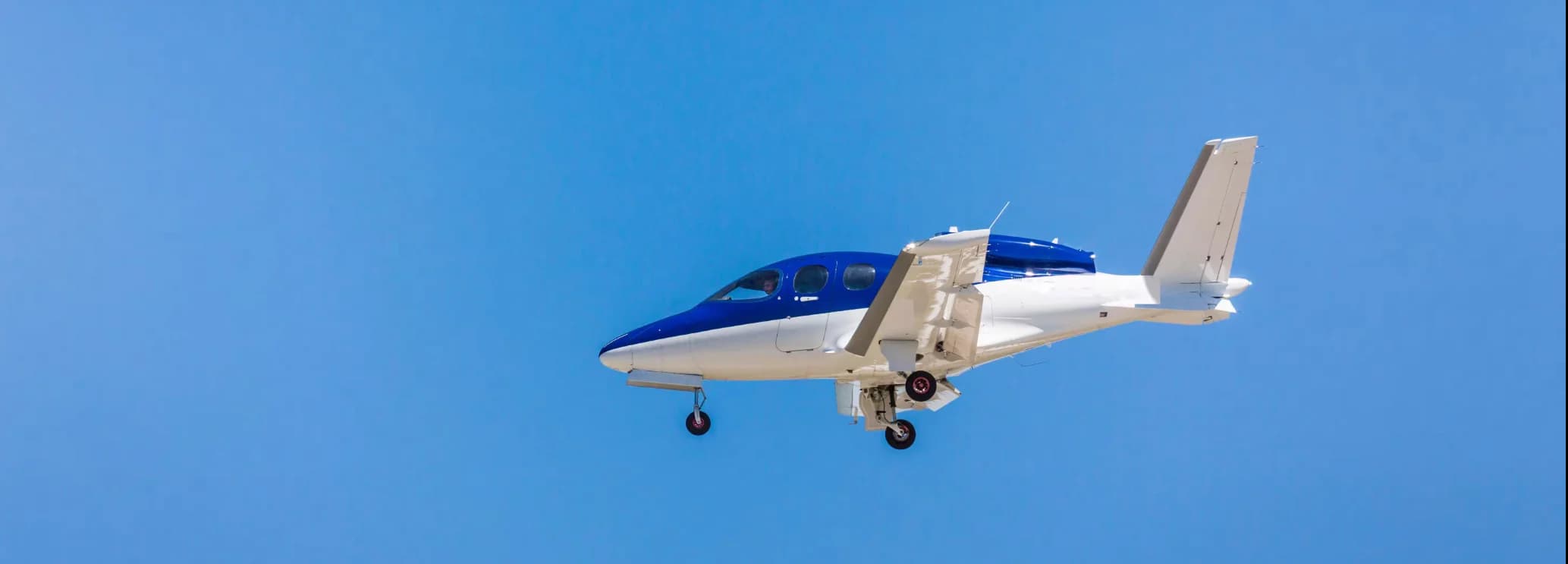
Cirrus Vision Jet
| Passengers | Range | Cruise Speed | Charter From | Best For |
|---|---|---|---|---|
| Up to 5 | 1,200 nm (1,381 mi) | 311 ktas (358 mph) | $2,200/hr | Short trips, parachute-equipped safety margin |
Note: The hourly rate is not the total trip cost. Final pricing includes landing and handling fees, crew, overflight permits, and taxes, plus variable costs such as repositioning, de-icing, wait time, and overnights. Contact Hogani Jets for an accurate all-in quote.
Charter of a Cirrus Vision Jet (SF50) starts at $2,200 to $2,700 per flight hour, putting true jet speed within reach at near-turboprop pricing. The Vision Jet is a single-engine very light jet manufactured by Cirrus Aircraft, in production since 2016, seating up to five passengers with a range of 1,200 nautical miles (1,381 miles) and a 311-knot cruise speed (358 mph). It is the only jet in production equipped with a whole-airframe parachute system. Hogani Jets coordinates each Vision Jet charter through licensed Part 135 operators.
Marketed by Cirrus as the first Personal Jet, the Vision Jet pairs true jet cruise speed with the single-pilot simplicity and safety philosophy Cirrus built its reputation on with the SR-series piston aircraft. It is the only jet in production today equipped with the Cirrus Airframe Parachute System (CAPS), a whole-aircraft parachute that can bring the entire jet, passengers included, to the ground in an emergency, a safety feature unmatched anywhere else in business aviation.
A single Williams International FJ33 turbofan, a V-tail design, and the Cirrus Perspective avionics suite by Garmin round out an aircraft built for owner-operators and short-haul charter alike. The Vision Jet suits travelers who want jet speed and a five-seat cabin on trips under roughly 1,000 miles, at a rate close to a turboprop.
The Vision Jet entered production in 2016 as Cirrus Aircraft's first jet and the first aircraft in its class equipped with a whole-airframe parachute system. A single Williams International FJ33 fanjet, a composite airframe, and the familiar Cirrus Perspective avionics suite make it one of the most distinctive aircraft in the very light jet category.
| Specification | Cirrus Vision Jet (SF50) |
|---|---|
| Manufacturer | Cirrus Aircraft |
| Aircraft Category | Very Light Jet |
| Passenger Capacity | Up to 5 |
| Cabin Length | 10.8 ft (3.29 m) |
| Cabin Width | 5.0 ft (1.52 m) |
| Cabin Height | 4.1 ft (1.25 m) |
| Baggage Capacity | 26 cu ft (0.7 m³) |
| Max Range | 1,200 nm (1,381 mi) |
| Max Cruise Speed | 311 ktas (358 mph) |
| Engine | 1 × Williams International FJ33 |
| Safety System | Cirrus Airframe Parachute System (CAPS) |
| Hourly Charter Rate | $2,200 to $2,700 |
The Vision Jet is the only jet in production equipped with a whole-airframe parachute. In an emergency, the Cirrus Airframe Parachute System deploys a single large parachute that lowers the entire aircraft, cabin and all, to the ground, rather than relying on individual ejection or a forced landing. CAPS carries over from the Cirrus SR-series piston aircraft, where it has an established real-world deployment record, and is a defining safety differentiator that no competing very light jet currently offers.
A very light jet trades a turboprop's lowest-in-class operating cost for true jet cruise speed. At $2,200 to $2,700 per hour, the Vision Jet runs above a turboprop such as the Pilatus PC-12 NG, but its 311-knot cruise covers short to medium routes faster, which matters once a trip stretches past a couple hundred miles.
- Faster cruise: 311 ktas versus roughly 270 to 290 ktas for a turboprop.
- Higher cost: $2,200 to $2,700 per hour versus $1,100 to $1,900 for a turboprop.
- Unique safety margin: the only aircraft in its category with a whole-airframe parachute system.
- Best mission: short to medium-haul trips for up to five passengers where jet speed and the CAPS safety system matter more than a turboprop's short-field access.
The Vision Jet comfortably seats four in a standard executive configuration, with capacity up to five depending on layout.
- Reclining seats, work and tray tables, and large windows are standard across the cabin.
- Vapor-cycle air conditioning keeps the cabin comfortable on the ground and in flight.
- An optional enclosed lavatory is available on most production aircraft; confirm availability at booking.
- Wide door and low step height simplify boarding and loading compared to many competing VLJs.
The Vision Jet performs best on short to medium-haul regional routes where its jet speed and CAPS safety margin add value over a turboprop.
| Route | ICAO Codes | Est. Flight Time | Notes |
|---|---|---|---|
| Los Angeles to Las Vegas | KVNY to KLAS | ~1h | Quick Western hop |
| New York to Martha's Vineyard | KTEB to KMVY | ~1h 15m | Regional resort run |
| Phoenix to Las Vegas | KPHX to KLAS | ~1h | Short Vegas leg |
| Denver to Aspen | KAPA to KASE | ~45m | Short mountain access |
Cirrus Vision Jet charter rates run $2,200 to $2,700 per flight hour, positioning it close to turboprop pricing with true jet speed. Total one-way trip pricing depends on route distance, positioning, and demand.
Contact Hogani Jets at charter@hoganijets.com or +1-855-660-0573 for a current quote.
| Route | Est. One-Way Price | Notes |
|---|---|---|
| Los Angeles to Las Vegas | $5,200 to $7,200+ | Quick Western hop |
| New York to Martha's Vineyard | $5,800 to $8,200+ | Regional resort run |
| Phoenix to Las Vegas | $5,000 to $7,400+ | Short Vegas leg |
| Denver to Aspen | $5,200 to $7,500 | Short mountain access |
The $2,200 to $2,700 hourly rate covers core operational costs. Additional fees are quoted separately on every trip, which matters when comparing total trip prices.
- Aircraft operation: fuel, crew, and maintenance are included in the hourly rate.
- Pilots: the Vision Jet is single-pilot certified but commonly flies with two pilots in charter service.
- Federal excise tax and segment fees: federally mandated, quoted separately.
- Positioning costs: charged if the aircraft must reposition to your departure airport.
- International handling fees: apply on Bahamas, Canada, and other international hops.
Contact Hogani Jets team for current Cirrus Vision SF50 private jet pricing.
The most common cross-shop comparisons are the Embraer Phenom 100 and the HondaJet, both competing very light jets. The Vision Jet is the only one with a whole-airframe parachute system; the Phenom 100 and HondaJet offer twin-engine redundancy and, in the HondaJet's case, more range and speed.
| Specification | Vision Jet (SF50) | Phenom 100 | HondaJet |
|---|---|---|---|
| Type | Single-engine VLJ | Twin-engine VLJ | Twin-engine VLJ |
| Passengers | Up to 5 | Up to 5 | Up to 6 |
| Range | 1,200 nm | 1,178 nm | 1,223 nm |
| Cruise Speed | 311 ktas (358 mph) | 380 ktas (437 mph) | 420 ktas (483 mph) |
| Hourly Rate | $2,200 to $2,700 | $1,900 to $2,500 | $2,000 to $2,600 |
| Best Use Case | Unique parachute safety system | Wide cabin, modern avionics | Speed and range in a VLJ |
Hogani Jets coordinates each Cirrus Vision Jet SF50 charter through licensed Part 135 operators. Hogani Jets does not operate the aircraft directly. Every charter is conducted by a licensed Part 135 direct air carrier whose crew, maintenance, and operations remain under that carrier's independent operational control, with certifications and safety records reviewed as part of every booking.
The Vision Jet is a strong fit for short Western legs where jet speed adds value over a turboprop without needing a larger cabin. The following Hogani Jets route pages cover its most relevant charter corridors.
Los Angeles to Las Vegas private jet charter
Las Vegas to Los Angeles private jet charter
Phoenix to Las Vegas private jet charter
| Relationship | Aircraft | When to Consider |
|---|---|---|
| Competing Very Light Jet | Embraer Phenom 100 | Twin-engine redundancy, wider cabin |
| Competing Very Light Jet | HondaJet | More speed and range in the same VLJ category |
| Step-Down Turboprop | Pilatus PC-12 NG | Lower hourly cost when jet speed is not required |
| Entry Light Jet | Citation CJ3 | Step up to more cabin and range |
Ready to book a Cirrus Vision Jet charter or check availability? Contact Hogani Jets for a tailored quote.
Call +1-855-660-0573 or email charter@hoganijets.com, and our team will coordinate the right aircraft and operator for your trip.
Reviewed by Matt Hogan — Founder, Hogani Jets & Aviation Specialist.
How much does it cost to charter a Cirrus Vision Jet?
Cirrus Vision Jet charter rates run $2,200 to $2,700 per flight hour. One-way trip pricing ranges from about $5,000 for short regional hops to $13,200 or more on longer runs. Final cost depends on route, positioning, and season.
What makes the Cirrus Vision Jet different from other very light jets?
The Vision Jet is the only jet currently in production equipped with the Cirrus Airframe Parachute System, a whole-aircraft parachute that can lower the entire jet to the ground in an emergency. No other VLJ available through Hogani Jets offers this safety system.
Is the Cirrus Vision Jet safe?
Yes. The Vision Jet carries the Cirrus Airframe Parachute System as standard equipment, a feature with an established real-world deployment record on Cirrus's piston aircraft. Charter safety also depends on the operator, maintenance, and crew training, all of which Hogani Jets verifies through ARGUS or Wyvern rated operators.
What is the range of the Cirrus Vision Jet?
The Vision Jet has a range of 1,200 nautical miles (1,381 miles), suited to short and medium-haul charter routes. For longer trips, a light jet such as the Citation CJ3 is the better fit.
How many passengers can the Cirrus Vision Jet carry?
The Vision Jet seats up to five passengers, with four typical in a standard executive layout. Cabin width and headroom are comparable to other very light jets in its category.
How fast does the Cirrus Vision Jet fly?
The Vision Jet cruises at 311 knots true airspeed (358 mph), true jet speed from a single-engine aircraft, though slower than twin-engine VLJs such as the Phenom 100 or HondaJet.
Is a single-engine jet safe to charter?
Yes. Single-engine jet certification requires the same rigorous safety standards as multi-engine aircraft, and the Vision Jet adds the CAPS whole-airframe parachute as an additional safety layer not found on twin-engine competitors. All Vision Jet charters coordinated through Hogani Jets are flown by licensed Part 135 operators.
What is the difference between the Vision Jet and the Phenom 100?
Both are five-seat very light jets in a similar price band. The Phenom 100 is twin-engine and faster at 380 ktas; the Vision Jet is single-engine, slightly slower at 311 ktas, and uniquely equipped with the CAPS whole-airframe parachute system.
Are empty leg flights available on the Vision Jet?
Yes. The Vision Jet's frequent regional positioning creates empty-leg opportunities at meaningful savings off standard one-way rates. Availability is short-notice and date-fixed, so Hogani Jets recommends flexibility when chasing empty-leg pricing.
Is Hogani Jets a direct air carrier?
No. Hogani Jets is an air charter broker and does not own or operate aircraft. All Vision Jet charters are facilitated through licensed Part 135 direct air carriers, who maintain full operational control and regulatory compliance for every flight.
Last Updated: 23 Sep 2026, 12:32 PM
About Us
Hogani Jets was built on a simple belief: real luxury is quiet, personal, and effortless. We work with a curated list of operators and a small client base so we can give every journey the attention it deserves.
Instant Charter Estimate

Compare Aircraft
Compare private jet categories side by side, range, cabin, passenger capacity, and hourly cost to find the right aircraft for your mission and route.
Your Guide: Hogani Jets Uncensored
Hogani Jets Uncensored: Submit your details for your free guide to private jet programs, honest truths, pricing and more.
