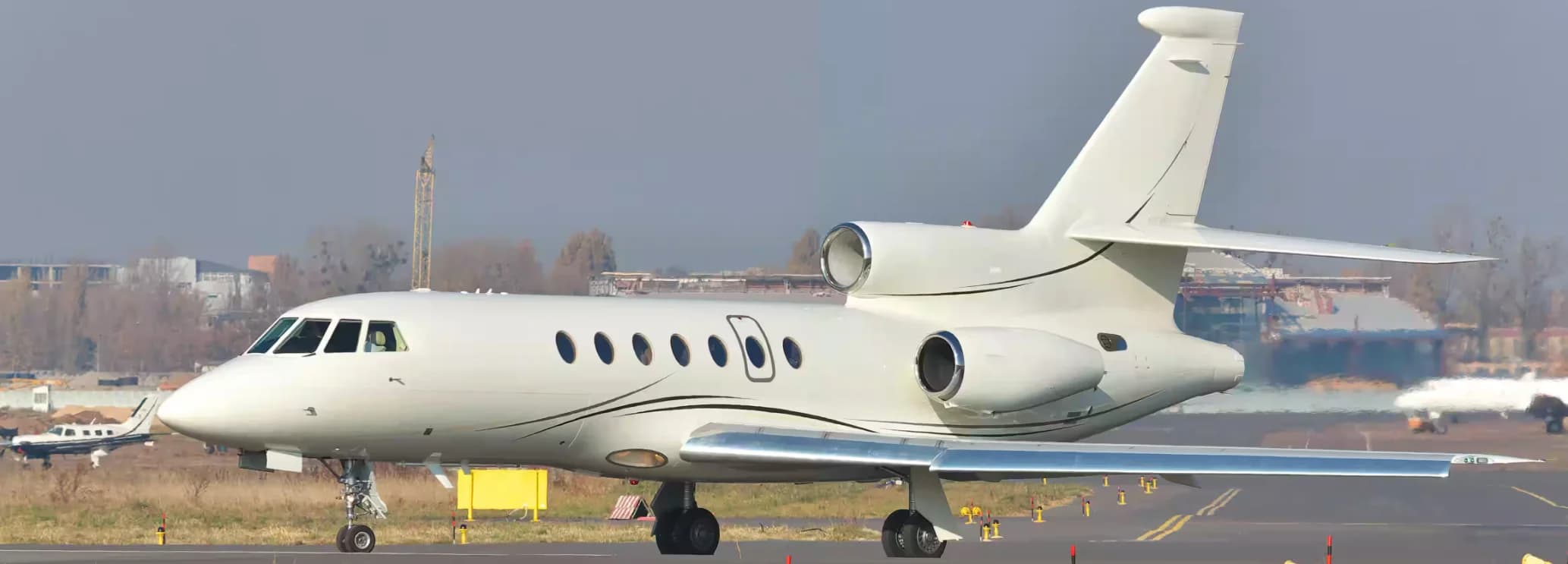
Dassault Falcon 50 private jet in flight, showcasing its trijet design and intercontinental charter capability

Falcon 50

PassengersRangeCruise SpeedCharter FromBest For
Up to 103,450 nm (3,971 mi)470 ktas (541 mph)$4,500/hrExecutive groups needing intercontinental range and trijet reliability at the super midsize rate

Note: The hourly rate is not the total trip cost. Final pricing includes landing and handling fees, crew, overflight permits, and taxes. Variable costs include repositioning, de-icing, wait time, and overnights. Contact Hogani Jets for an accurate all-in quote.

Charter of a Dassault Falcon 50 starts at $4,500 to $6,500 per flight hour. The Falcon 50 was the first private jet designed specifically for intercontinental range. French certification came in February 1979; FAA certification followed in March 1979. It seats up to 10 passengers in a 23.5-foot cabin across a 3,450-nautical-mile range at 470 knots. Three Honeywell TFE731-3-1C engines produce 3,700 lbf each. Hogani Jets coordinates each Falcon 50 charter through licensed Part 135 operators.

The Falcon 50 was the aircraft that proved a business jet could fly nonstop across the Atlantic. Dassault built on the twin-engine Falcon 20/200 design and added a third engine. The result was 3,450 nautical miles of range from a 23.5-foot cabin.

The first prototype flew on November 7, 1976. Customer deliveries began in July 1979. By that time, Dassault had modified the wing to incorporate a supercritical design. No private jet before it had offered comparable range.

Dassault produced the Falcon 50 from 1980 through 2006. The supercritical wing, three-engine configuration, and 49,000-foot ceiling defined this variant throughout its production run.

The Dassault Falcon 50 is a super midsize trijet certified in France in February 1979 and by the FAA in March 1979. It carries up to 10 passengers across a 3,450-nautical-mile range at 470 knots. Three Honeywell TFE731-3-1C engines produce 3,700 lbf each, per Honeywell specification data. Maximum takeoff weight is 38,320 lbs and service ceiling is 49,000 feet.

Specification

Falcon 50

Manufacturer

Dassault Aviation

Aircraft Category

Super midsize jet

Passenger Capacity

Up to 10

Cabin Length

23.5 ft (7.16 m)

Cabin Width

6.1 ft (1.86 m)

Cabin Height

5.9 ft (1.80 m)

Cabin Pressurization

6,000 ft cabin altitude at cruise

Baggage Capacity

115 cu ft

Lavatory

Enclosed aft

Flight Attendant

Typically included

Max Range

3,450 nm (3,971 mi)

Max Cruise Speed

470 ktas (541 mph)

Service Ceiling

49,000 ft

Max Takeoff Weight

38,320 lbs

Typical Takeoff Distance

~4,700 ft

Typical Landing Distance

~2,150 ft

Engines

3 x Honeywell TFE731-3-1C

Avionics

Collins ADC-80 + FCS-80F + Primus radar

Hourly Charter Rate

$4,500 to $6,500

Most super midsize jets use two engines. The Falcon 50 uses three. That decision was deliberate and defines the aircraft.

Two reasons drove the choice. First, range. Three TFE731-3-1C engines give the Falcon 50 the power and fuel capacity to reach 3,450 nautical miles. Twin-engine super midsize jets of the same era could not match it.

Per performance data, the Falcon 50 carries approximately 15,520 pounds of fuel across three separate tanks. Combined fuel consumption runs 2,100 to 2,200 pounds per hour. That endurance profile supports nonstop Atlantic crossings.

Second, ETOPS exemption. The Falcon 50 is a trijet, not a twin-engine aircraft. It does not require Extended-range Twin-engine Operations Performance Standards approval for transoceanic routing. This gives operators greater flexibility on routes where ETOPS certification adds complexity.

Per Dassault Aviation's certification documentation, the Falcon 50 was the first privately operated business jet certified for intercontinental range. The 8.7 psi maximum differential pressure maintains a sea-level cabin altitude to approximately 26,100 feet.

The Falcon 50EX is the upgraded version of the Falcon 50. The two aircraft share the same cabin, the same category, and the same charter rate. The differences are in the engines, avionics, and cockpit systems.

SpecificationFalcon 50

Falcon 50EX

Production1980-20061996-2008
Published Range3,450 nm3,350 nm
Cruise Speed470 ktas480 ktas
Max Takeoff Weight38,320 lbs39,700 lbs
Engines3 x Honeywell TFE731-3-1C3 x Honeywell TFE731-40
Engine ControlManualDEEC (Digital Electronic Engine Control)
AvionicsCollins FCS-80F + ADC-80Collins Pro Line 4
APUNot standardStandard equipment
PassengersUp to 10Up to 10
Cabin Dimensions23.5 x 6.1 x 5.9 ft23.5 x 6.1 x 5.9 ft
Service Ceiling49,000 ft49,000 ft
Hourly Charter Rate$4,500 to $6,500$4,500 to $6,500

For charter passengers, the cabin experience is identical. The 50EX's faster cruise (480 vs 470 kt) saves a few minutes per sector. Its Collins Pro Line 4 cockpit is more modern. The APU means the aircraft can pre-condition the cabin independently of ground power.
The Falcon 50EX is the stronger choice when availability and APU convenience matter. The original Falcon 50 is the right choice when it is the aircraft available at the rate. Both deliver the same cabin to the same destinations at the same hourly cost.

A super midsize jet trades higher cost for more cabin room and intercontinental range.

  • More range: 3,450 nautical miles versus 2,000 to 2,600 nm for most midsize jets.
  • More passengers: up to 10 versus 8 to 9 for most midsize aircraft.
  • Trijet configuration: ETOPS exemption and higher redundancy than twin-engine alternatives.
  • Intercontinental reach: New York to London (3,462 nm) is at the published range limit.
  • Best mission: transcontinental and short transatlantic routes for executive groups of 8 to 10.

The Falcon 50 seats up to 10 passengers. Standard charter layouts run 8 to 9.

  • A typical layout: a four-seat forward club, two facing seats with foldout tables, and a three-seat divan.
  • Three closets are standard for briefcases, suits, and coats.
  • Cabin height at 5.9 feet; most passengers under 5 feet 9 inches stand fully upright.
  • 14 cabin windows provide a well-lit interior with natural light across all rows.
  • A two-zone temperature regulation system uses bleed air from the center engine for cabin conditioning.
  • An enclosed aft lavatory includes a seat, extending total capacity to 10 when occupied.

The Falcon 50 cabin is 23.5 feet long, 6.1 feet wide, and 5.9 feet tall. Cabin pressurization holds a 6,000-foot equivalent altitude at cruise. The 8.7 psi maximum differential maintains a sea-level cabin to approximately 26,100 feet. Fourteen windows line the cabin. The aircraft seats up to 10 passengers with 115 cubic feet of baggage capacity.

For groups of 8 to 10 needing intercontinental range at the super midsize rate, the Falcon 50 is the only trijet in the category. The third engine is the aircraft's defining practical advantage.

The 3,450-nautical-mile range covers most transcontinental and some transatlantic routes. New York to London (3,462 nm) is at the published range limit with full payload. Confirm routing with Hogani Jets before booking that sector.

RouteICAO CodesEst. Flight TimeNotes
New York to MiamiKTEB to KMIA~2h 30mWell within range
Miami to DallasKMIA to KDAL~2h 20mCross-country business corridor
New York to Los AngelesKTEB to KVNY~5h 20m2,450 nm; well within range
New York to LondonKTEB to EGLL~6h 30m3,462 nm; at published range limit; confirm with Hogani Jets

The cost to charter a Falcon 50 is typically $4,500 to $6,500 per flight hour. New York to Los Angeles one-way rental runs approximately $39,750 to $49,600. New York to Miami one-way charter price is approximately $19,250 to $26,250. Final all-in cost depends on operator, routing, positioning, and season. Fuel, crew, and maintenance are included in the hourly rate; landing fees, taxes, and repositioning are billed separately.

Contact Hogani Jets at charter@hoganijets.com or +1-855-660-0573 for a current quote.

RouteEst. One-Way PriceNotes
New York to Miami$19,250 to $26,250+Domestic; well within range
Miami to Dallas$20,250 to $28,625+Cross-country corridor
New York to Los Angeles$39,750 to $49,600+Transcontinental nonstop
New York to Chicago$14,200 to $19,400+Short regional hop

The hourly rate covers core operational costs. Additional fees are quoted separately.

  • Aircraft operation: fuel, crew, and maintenance are included in the hourly rate.
  • Two certificated pilots: required for all operations.
  • Federal excise tax and segment fees: federally mandated, quoted separately.
  • Positioning costs: charged if the aircraft must reposition to your departure airport.
  • International handling fees: apply on Caribbean, Canada, and other international flights.

Contact Hogani Jets for current pricing and details.

At the same rate tier, the Falcon 50 competes with other super midsize jets. Its trijet configuration and range differentiate it from twin-engine alternatives. The Falcon 50EX is the direct upgrade.

SpecificationFalcon 50EXGulfstream G200Falcon 50
TypeSuper midsizeSuper midsizeSuper midsize
Production1996-20081999-20111980-2006
PassengersUp to 10Up to 10Up to 10
Published Range3,350 nm3,400 nm3,450 nm
Cruise Speed480 ktas488 ktas470 ktas
Engines3x TFE731-402x PW306A3x TFE731-3-1C
Hourly Rate$4,500 to $6,500$4,500 to $6,500$4,500 to $6,500
Best Use CaseUpgraded Falcon 50; Pro Line 4 cockpitFaster cruise; pressurized baggage holdOriginal trijet; intercontinental pioneer

Every Falcon 50 charter coordinated by Hogani Jets is operated by an FAA Part 135 certificated direct air carrier holding full operational control of the flight. Each operator's certificate, insurance coverage, and safety record is independently reviewed before Hogani Jets coordinates a booking. Hogani Jets is an air charter broker and does not own or operate aircraft.

The Falcon 50 carries Collins ADC-80 avionics with Primus color weather radar and radio altimeter. Three independent engine and fuel systems provide a level of redundancy unusual in the super midsize category. Hogani Jets independently reviews every operator's certificate and safety record before coordinating any Falcon 50 charter.

The Falcon 50 suits transcontinental domestic routes and select transatlantic sectors. The following Hogani Jets route pages cover its most common corridors.

RelationshipAircraftWhen to Consider
Direct UpgradeFalcon 50EXSame cabin; updated TFE731-40 engines; Collins Pro Line 4; APU standard
Contemporary CompetitorGulfstream G200Faster cruise (488 kt); pressurized baggage hold; twin-engine
Earlier DassaultFalcon 20Smaller; twin-engine; predecessor in the Dassault lineup
Modern AlternativeGulfstream G280Successor G200 platform; in current production; $5,000-7,000

Ready to book a Falcon 50 charter or check availability? Contact Hogani Jets for a tailored quote. Call +1-855-660-0573 or email charter@hoganijets.com.

Reviewed by Matt Hogan — Founder, Hogani Jets & Aviation Specialist.

How much does it cost to charter a Falcon 50?

Falcon 50 charter rates typically run $4,500 to $6,500 per flight hour. New York to Los Angeles one-way runs approximately $39,750 to $49,600. Final cost depends on route, operator, positioning, and season. 

Why does the Falcon 50 have three engines?

Dassault designed the Falcon 50 for intercontinental range. Three Honeywell TFE731-3-1C engines give it the fuel capacity to fly 3,450 nautical miles. The trijet configuration also exempts it from ETOPS requirements and provides higher redundancy than twin-engine alternatives.

What is the difference between the Falcon 50 and Falcon 50EX?

The 50EX upgraded the engines (TFE731-40 vs TFE731-3-1C), added Digital Electronic Engine Control, installed Collins Pro Line 4 avionics, and made an APU standard equipment. The cabin dimensions and charter rate are identical on both variants.

How many passengers can the Falcon 50 carry?

The Falcon 50 seats up to 10 passengers. Standard charter layouts run 8 to 9, with the 10th seat in the enclosed aft lavatory.

What was historically significant about the Falcon 50?

The Falcon 50 was the first private business jet designed for intercontinental range. Per Dassault Aviation, no privately operated business jet before it offered comparable nonstop capability.

What is the real range of a Falcon 50?

Published range is 3,450 nautical miles. Realistic range with a full cabin runs somewhat lower depending on routing and reserves. New York to London (3,462 nm) is at the published limit; confirm with Hogani Jets before booking.

Are empty leg flights available on the Falcon 50?

Yes. Repositioning flights create empty-leg opportunities on both Falcon 50 variants. Availability is short-notice and date-fixed; Hogani Jets recommends flexibility when pursuing empty-leg pricing.

Is Hogani Jets a direct air carrier?

No. Hogani Jets is an air charter broker and does not own or operate aircraft. All Falcon 50 charters are facilitated through licensed Part 135 direct air carriers holding full operational and regulatory control.

Last Updated: 23 Sep 2026, 01:02 PM

About Us

Hogani Jets was built on a simple belief: real luxury is quiet, personal, and effortless. We work with a curated list of operators and a small client base so we can give every journey the attention it deserves.

Instant Charter Estimate
compareairCraft1cloud
compareairCraft2cloud

Compare Aircraft

Compare private jet categories side by side, range, cabin, passenger capacity, and hourly cost to find the right aircraft for your mission and route.
https://d2fh6kg71io623.cloudfront.net/uploads/cms/1783689472835_cropped-image.webp

Your Guide: Hogani Jets Uncensored

Hogani Jets Uncensored: Submit your details for your free guide to private jet programs, honest truths, pricing and more.