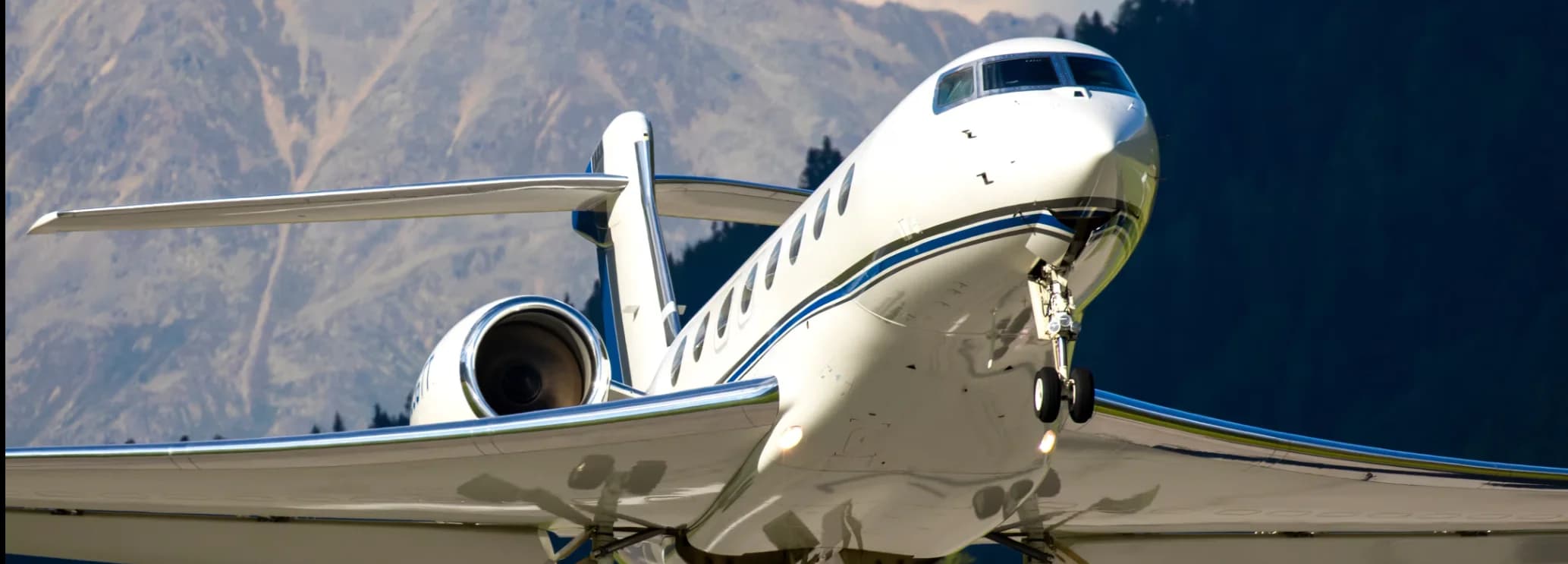
Heavy Jet vs Ultra Long Range Jet: The Core Difference
A heavy jet covers 4,000 to 6,000 nautical miles with a full stand-up cabin for 10 to 16 passengers. An ultra long range jet extends beyond 6,500 nautical miles with zone-based cabins that include dedicated staterooms, crew rest areas, and, on some models, shower facilities. The decision between the two comes down to route length, mission duration, and whether the cabin needs to function as a sleeping environment. Below 6,000 nautical miles, the heavy jet handles most intercontinental missions at lower cost. Above that threshold, the ultra long range jet eliminates fuel stops the heavy jet cannot avoid.
A heavy jet is a large-cabin, long-range business aircraft designed for international travel and groups of 10 to 16 passengers. The category sits above super midsize jets in both cabin volume and operating cost, and below ultra long range jets in raw range.
Cabin height in the heavy jet category runs 6.1 to 6.3 feet. Width extends to 7.2 to 8.2 feet. Most heavy jets feature two to three distinct cabin zones, allowing separate work and lounge areas within the same aircraft. Lie-flat divan seating is standard on most models. A flight attendant is included on virtually all heavy jet operations.
The heavy jet is the right category when routes stay under 6,000 nautical miles, and the mission does not require overnight rest capability beyond what a divan provides. For most transatlantic routes, it is the more economical choice.
The Bombardier Challenger 650 seats 12 passengers in a wide-body cabin of 7.1 feet. A range of 4,000 nautical miles makes it a strong performer on transatlantic routes with favorable winds. Charter rate: $5,500 to $8,000 per hour.
The Dassault Falcon 900LX delivers 4,750 nautical miles on three engines, providing an additional safety margin over twin-engine alternatives. Its cabin seats up to 12 passengers. Charter rate: $5,500 to $8,000 per hour.
Heavy jets cover 4,000 to 6,000 nautical miles nonstop with full stand-up cabins of 6.1 to 6.3 feet height for 10 to 16 passengers. Standard features include lie-flat divan seating, dedicated galley, and at least one flight attendant. Charter rates run $5,500 to $8,000 per hour in 2026. Heavy jets handle most transatlantic routes, including New York to London and Miami to Zurich, without a fuel stop.
An ultra long range jet is the highest category in business aviation. These aircraft are built specifically for missions exceeding 6,000 nautical miles and for passengers who need the cabin to function as a complete living environment across 12- to 16-hour flights.
The category is defined not just by range, but by cabin architecture. Where a heavy jet offers two to three zones, an ultra long range jet organizes the cabin into three to four dedicated living spaces: a forward lounge, a conference or dining area, a social zone, and a private stateroom with a full-size bed. The separation of these zones transforms a long flight from an endurance exercise into a structured, productive, and restful experience.
Pressurization technology in this category is meaningfully advanced. Lower cabin altitudes reduce dehydration and passenger fatigue on long segments. This is not a marketing claim. The physiological difference between a 6,000-foot cabin altitude and a 2,900-foot cabin altitude across a 14-hour flight is measurable on arrival.
The Bombardier Global 7500 is the industry's only purpose-built four-zone business jet. Cabin dimensions: 54.4 feet long, 8 feet wide, 6.2 feet tall. Range: 7,700 nautical miles. Cabin altitude at cruise: approximately 4,850 feet (upgradeable to 2,691 feet in the Global 8000 configuration). The Global 7500 holds the record for the longest business aviation flight ever flown: Sydney to Detroit at 8,225 nautical miles in 2019. It also holds the Singapore to Tucson record at 8,152 nautical miles. The aircraft carries 195 cubic feet of in-flight accessible baggage. Charter rate:$12,000 to $17,000 per hour.
The Gulfstream G700 delivers 7,750 nautical miles from what Gulfstream describes as the largest cabin in its class, measuring 56 feet with up to five living areas and 20 oval windows. The G700 is pressurized to the lowest cabin altitude in its class, further reducing fatigue on ultra-long segments. Charter rate:$12,000 to $17,000 per hour .
The Gulfstream G650ER delivers 7,500 nautical miles at Mach 0.85 and remains one of the most in-demand aircraft on the charter market. Production of the G650 ended, but the G650ER remains actively sought for its combination of range, speed, and cabin quality. Charter rate: $11,000 to $16,000 per hour.
The Dassault Falcon 8X delivers 6,450 nautical miles on three engines. Three cabin zones, 30 windows, and a particularly quiet cabin environment. The tri-engine configuration provides operational flexibility at airports where twin-engine aircraft face extended diversion requirements. Charter rate:$9,000 to $13,000 per hour
The Gulfstream G550 is one of the most widely operated ultra long range jets globally. It delivers approximately 6,750 nautical miles of range from a four-zone cabin with 1,669 cubic feet of volume. Production ended in July 2021, but more than 600 aircraft remain in active service with 99.9 percent dispatch reliability. Charter rate: $9,000 to $13,000 per hour.
The Bombardier Global 5500 seats up to 16 passengers across three cabin zones with a range of 5,900 nautical miles. It offers flat-bed sleeping and full galley service. Charter rate: $9,000 to $13,000 per hour.
Ultra long range jets deliver 6,500 to 8,000 or more nautical miles nonstop with zone-based cabins of 3 to 4 dedicated living spaces. The Bombardier Global 7500 holds the longest business aviation flight record at 8,225 nautical miles, maintains a cabin altitude of approximately 4,850 feet at cruise, and features 195 cubic feet of in-flight accessible baggage. The Gulfstream G700 delivers 7,750 nautical miles with five cabin areas and 20 oval windows. Charter rates run $9,500 to $20,000 per hour in 2026.
Specification | Heavy Jet | Ultra Long Range Jet |
|---|---|---|
Typical seating | 10 to 16 passengers | 10 to 19 passengers |
Cabin height | 6.1 to 6.3 feet | 6.1 to 6.4 feet |
Cabin width | 7.2 to 8.2 feet | 7.9 to 8.2 feet |
Cabin zones | 2 to 3 zones | 3 to 4 dedicated zones |
Range | 4,000 to 6,000 nm | 6,500 to 8,000+ nm |
Cabin altitude at cruise | 6,000 to 8,000 feet | 2,900 to 6,000 feet |
Stateroom / full bed | Not standard | Standard on most models |
Shower facilities | Not available | Available (G700, Global 7500) |
In-flight baggage access | Limited | Full access (Global 7500: 195 cu ft) |
Flight attendants | 1 | 1 to 2 |
Charter rate (2026) | $5,500 to $8,000/hr | $9,500 to $20,000/hr |
Best for | Transatlantic, up to 6,000 nm | Transpacific, over 6,000 nm |
The boundary between these two categories is most clearly defined at 6,000 nautical miles. Below that, the heavy jet covers the mission. Above it, the ultra long range category becomes operationally necessary.
Routes that the heavy jet handles without a stop include New York to London (3,450 nm), Miami to Zurich (5,120 nm), and Los Angeles to Tokyo with favorable winds in some configurations. The Gulfstream G550, at 6,750 nautical miles, is classified as an ultra long range jet.
Routes that consistently require the ultra long range category include New York to Dubai (6,840 nm), London to Singapore (6,745 nm), and Los Angeles to Sydney (7,500 nm). These city pairs cannot be served reliably nonstop by standard heavy jets regardless of conditions.
A fuel stop on a long-haul route is not simply an inconvenience. It carries real operational and financial costs that are often underestimated when comparing heavy jet and ultra long range options.
Fuel stops add one to two hours of ground time at the transit airport. Airport handling fees at major international stops, Dubai, Singapore, Doha, can add $3,000 to $8,000 to the trip cost. Combined with the additional flight time and crew costs, a fuel stop on a New York to Singapore segment might add $15,000 to $25,000 to the total invoice.
The second factor is crew duty time. On segments exceeding 10 hours, FAA and EASA crew rest regulations may require a crew change at the fuel stop. This is not a preference. It is a regulatory requirement. A crew change at an international transit point means sourcing and positioning a relief crew, adding both cost and scheduling complexity that the ultra long range non-stop routing eliminates entirely.
A fuel stop on a long-haul private jet route adds more than transit time. Airport handling fees at major international stops typically add $3,000 to $8,000. On segments exceeding 10 hours, FAA and EASA crew duty time regulations may require a crew change at the transit point, adding crew positioning costs and scheduling complexity. On a New York to Singapore routing, these combined factors can add $15,000 to $25,000 to the total trip cost compared to a nonstop ultra long range operation.
Both categories offer full stand-up cabins. The physical difference in ceiling height is minor. The meaningful difference is in how the cabin is organized for extended occupancy.
A heavy jet cabin is designed for eight to ten hours. The divan converts to a flat sleeping surface, the galley provides full meal service, and the cabin zones allow some separation of work and rest. For a 10-hour transatlantic segment, most experienced travelers find a heavy jet cabin entirely adequate.
An ultra long range cabin is designed for 12 to 16 hours. The separation of zones into genuinely distinct spaces, a dedicated stateroom with a door, a separate dining area, and a lounge that functions independently, changes the passenger experience in a way that specification sheets cannot fully capture.
On the Global 7500, passengers describe the transition between zones across a 14-hour flight in structured terms: work in the forward club, a meal at the dining table, a social hour in the lounge, then retiring to the stateroom while still 7 hours from landing. That sequence is usually not possible in a heavy jet because the physical separation of spaces does not exist on most models.
Cabin altitude is the simulated altitude the pressurization system maintains inside the aircraft while cruising at 40,000 to 51,000 feet. Lower cabin altitude means more oxygen, less dehydration, and less passenger fatigue on arrival.
Most heavy jets maintain a cabin altitude of 6,000 to 8,000 feet at cruise. The Bombardier Challenger 650, a heavy jet, maintains a cabin pressure equivalent to an altitude of 5,800 feet at cruise. This relatively low cabin altitude helps provide a comfortable environment for passengers on long flights. With a cabin measuring 28.3 feet long, 8.2 feet wide, and 6.1 feet high, the Challenger 650 accommodates up to 12 passengers.
The Bombardier Global 7500 maintains a cabin altitude of approximately 4,850 feet at cruise altitude. The Global 8000 variant achieves 2,691 feet, the lowest of any business jet in production. The Gulfstream G700 pressurizes to the lowest cabin altitude in its class. These are not marginal differences. On a 14-hour sector, the combination of a lower cabin altitude, higher humidity control, and circadian lighting systems in the ultra long range category produces measurably better passenger condition on arrival.
Choose a heavy jet when your primary routes fall within 4,000 to 6,000 nautical miles. For most transatlantic travel, New York to London, Miami to Paris, Chicago to Dubai via a stop, the heavy jet delivers a full international cabin experience at approximately 20 to 40 percent lower charter cost than comparable ultra long range jets, depending on the aircraft and mission.
The heavy jet is also the practical choice when the destination airport has runway or weight constraints that limit ultra long range aircraft. Major ultra long range jets have higher maximum takeoff weights that restrict access to some airports. Confirm airport compatibility before specifying aircraft category on any route.
Choose an ultra long range jet when any of three conditions apply. First, when the route exceeds 6,000 nautical miles and a fuel stop is operationally or commercially unacceptable. Second, when the segment duration exceeds 12 hours, and the cabin must provide genuine rest capability rather than just a flat surface. Third, when the stateroom and shower availability are operational requirements for the passenger.
For executives traveling to Asia, the Gulf, or Australia from North America or Europe, the ultra long range category is not a luxury upgrade. It is the correct operational choice. Arriving in Singapore or Hong Kong after a 13-hour flight in a heavy jet is a meaningfully different experience from arriving in a Global 7500 stateroom. The difference shows in the first meeting.
The hourly charter premium for an ultra long range jet can be approximately 30 to 60 percent over a comparable heavy jet, depending on the specific aircraft and mission. On a 14-hour sector that eliminates a fuel stop, reduces crew change costs, and delivers passengers in better condition, the total economics of the ultra long range routing often justify the premium.
Matt's Recommendation
If your primary routes stay under 6,000 nautical miles, the heavy jet is the right choice. The operating cost saving over ultra long range rates is real and significant. Reserve the ultra long range category for routes that genuinely require more than 6,000 nautical miles nonstop, or for missions where the stateroom and zone separation are operational requirements rather than preferences. For clients on the boundary, run the fuel stop cost analysis before deciding.
Reviewed by Matt Hogan — Founder, Hogani Jets & Aviation Specialist.
What is the difference between a heavy jet and an ultra long range jet?
Heavy jets cover 4,000 to 6,000 nautical miles with 2 to 3 cabin zones for 10 to 16 passengers. Ultra long range jets extend to 6,500 to 8,000+ nautical miles with 3 to 4 dedicated zones including staterooms. Ultra long range jets can cost approximately 30 to 60 percent more per hour than comparable heavy jets, depending on the aircraft and mission.
When should I choose an ultra long range jet over a heavy jet?
Choose an ultra long range jet when routes consistently exceed 6,000 nautical miles nonstop, when flight duration exceeds 12 hours and a stateroom is needed, or when crew duty time rules make a fuel stop operationally complex. For routes under 6,000 nautical miles, the heavy jet is more economical.
What is the range of an ultra long range private jet?
Ultra long range jets deliver 6,500 to 8,000 or more nautical miles nonstop. The Global 7500 holds the record at 8,225 nautical miles Sydney to Detroit. The Gulfstream G700 delivers 7,750 nautical miles. Both connect any two cities on earth without a fuel stop.
Do ultra long range jets have private bedrooms?
Yes. Most ultra long range jets include a dedicated stateroom with a full-size bed. The Global 7500 was the first purpose-built business jet with four distinct cabin zones including a private stateroom. The Gulfstream G700 offers up to a similar layout as well with up to four different cabin zones. Heavy jets offer lie-flat divans but no enclosed stateroom.
What is the hourly charter rate for an ultra long range jet?
Ultra long range jets charter at $9,500 to $20,000 or more per hour in 2026. The Gulfstream G700 and Global 7500 sit at the higher end. Ultra long range jets can cost approximately 30 to 60 percent more per hour than comparable heavy jets, depending on the specific aircraft and mission. The premium is justified when the route or mission genuinely requires the category.
Can a ultra long range jet fly New York to Dubai nonstop?
The Gulfstream G700 is a ULR-category aircraft with a range of 7,500 nautical miles. Its ability to operate New York to Dubai nonstop depends on factors such as payload, winds, and routing, so actual flight planning may require a fuel stop.
What cabin altitude do ultra long range jets maintain?
The Global 7500 maintains approximately 4,850 feet cabin altitude at cruise. The Global 8000 achieves 2,691 feet, the lowest of any business jet in production. The Gulfstream G700 maintains the lowest cabin altitude in its class. Lower cabin altitude reduces fatigue on 12 to 16 hour flights.
Is a heavy jet comfortable enough for a 10-hour flight?
Yes. Heavy jets include lie-flat divan seating, full galley service, and a flight attendant. A 10-hour transatlantic segment is within the design envelope of the category. For segments exceeding 10 hours, the dedicated stateroom of the ultra long range category provides meaningfully better rest.
What are the most popular ultra long range jet models?
The most widely chartered ultra long range jets in 2026 are the Bombardier Global 7500, Gulfstream G700, Gulfstream G650ER, and Dassault Falcon 8X. The Global 7500 and G700 are current production flagships. The G650ER remains highly sought despite G650 production ending.
Does a fuel stop on a heavy jet actually cost more than an ultra long range jet?
On long segments, it often does. Fuel stop handling fees add $3,000 to $8,000 at major international airports. Crew duty time rules on segments over 10 hours may require a crew change, adding positioning cost and complexity. On a 14-hour routing, these combined factors can reduce or eliminate the heavy jet cost advantage.
Last Updated: 14 Sep 2026, 12:13 PM
About Us
Hogani Jets was built on a simple belief: real luxury is quiet, personal, and effortless. We work with a curated list of operators and a small client base so we can give every journey the attention it deserves.
Instant Charter Estimate


Compare Aircraft
Compare private jet categories side by side, range, cabin, passenger capacity, and hourly cost to find the right aircraft for your mission and route.
Your Guide: Hogani Jets Uncensored
Hogani Jets Uncensored: Submit your details for your free guide to private jet programs, honest truths, pricing and more.
