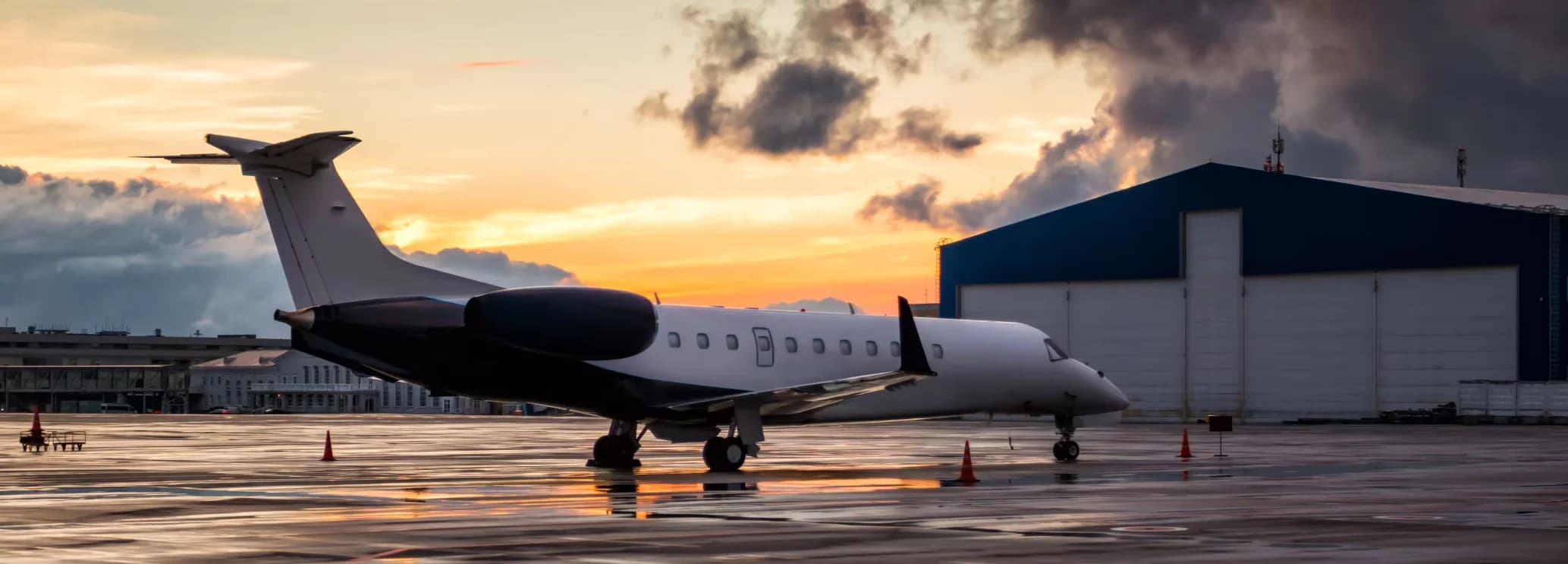
Private Jet Speed Explained: Knots, Mach, and MPH
Private jets cruise at 400 to 525 knots (460 to 605 mph) at 35,000 to 45,000 feet. Turboprops fly slower at 260 to 360 knots. The Bombardier Global 8000 is the fastest private jet in the world, featuring a maximum operating speed of Mach 0.94, which translates to roughly 721 mph at cruising altitude.. Most private jets cruise at Mach 0.75 to 0.90. At 35,000 feet, Mach 1 equals approximately 573 knots (659 mph). Private jets are generally comparable to or faster than commercial narrow-body aircraft.
Speed varies significantly by aircraft category. The table below covers all nine categories with typical cruise speed, maximum speed, and equivalent Mach numbers.
Category | Typical Cruise | Max Speed | Mach Range | Example Aircraft |
|---|---|---|---|---|
Turboprop | 260-360 kt(299-414 mph) | 380 kt(437 mph) | N/A (propeller) | King Air 350, PC-12 NGX |
Very Light Jet | 380-415 kt(437-478 mph) | 430 kt(495 mph) | M0.68-0.73 | HondaJet Elite II, Phenom 100EV |
Light Jet | 420-455 kt(483-524 mph) | 470 kt(541 mph) | M0.72-0.80 | Citation XLS, Hawker 750 |
Midsize Jet | 430-465 kt(495-535 mph) | 480 kt(552 mph) | M0.75-0.82 | Falcon 2000, Challenger 300 |
Super Midsize | 440-478 kt(506-550 mph) | 490 kt(564 mph) | M0.80-0.85 | Challenger 350, Citation X |
Heavy Jet | 450-480 kt(518-552 mph) | 500 kt(575 mph) | M0.82-0.87 | Challenger 650, Falcon 900 |
Ultra-Long-Range | 460-525 kt(529-604 mph) | 535 kt(616 mph) | M0.85-0.935 | G700, Global 7500, Citation X+ |
VIP Airliner | 450-490 kt(518-564 mph) | 510 kt(587 mph) | M0.78-0.86 | BBJ, ACJ, 787 VIP |
Commercial (A320/737) | 450-485 kt(518-558 mph) | 487 kt(560 mph) | M0.78-0.84 | A320, Boeing 737 |
Ultra-long-range jets are the fastest category. The Citation X+ at 525 knots holds the speed record for certified production civilian aircraft. Most heavy and ULR jets cruise at similar speeds to commercial wide-body aircraft.
Private jets cruise at 460 to 604 mph depending on category. Converting knots to mph: multiply knots by 1.151. The table below gives common reference speeds in both units.
Speed in Knots | Speed in mph | Mach (at 35,000 ft) | What Flies at This Speed |
|---|---|---|---|
260 kt | 299 mph | M0.45 | Turboprop cruise (typical) |
400 kt | 460 mph | M0.70 | VLJ cruise (typical) |
450 kt | 518 mph | M0.79 | Light/midsize jet cruise |
480 kt | 552 mph | M0.84 | Heavy jet cruise |
510 kt | 587 mph | M0.89 | ULR jet cruise (typical) |
525 kt | 604 mph | M0.935 | Citation X+ (fastest production jet) |
573 kt | 659 mph | M1.00 | Speed of sound at 35,000 ft |
675 kt | 777 mph | M1.18 | Speed of sound at sea level |
A Mach number expresses speed as a ratio to the local speed of sound. Mach 1 equals the speed of sound at the aircraft's current altitude and temperature.
At sea level, Mach 1 equals approximately 661 knots (761 mph). At 35,000 feet, where private jets cruise, Mach 1 equals approximately 573 knots (659 mph). The lower air temperature at altitude reduces the speed of sound.
Most private jets operate between Mach 0.75 and Mach 0.90 at cruise altitude. The Citation X+ at Mach 0.935 is the closest any production civilian aircraft reaches to the speed of sound in regular operation.
Mach Number | Speed at 35,000 ft | What It Means for Private Jets |
|---|---|---|
M0.70 | 401 kt / 462 mph | VLJ cruise; slower end of jet speeds |
M0.75 | 430 kt / 495 mph | Light and midsize jet typical cruise |
M0.80 | 459 kt / 528 mph | Mid-range cruise for most business jets |
M0.85 | 487 kt / 561 mph | Typical for heavy and super midsize jets |
M0.90 | 516 kt / 594 mph | Fast ULR cruise; Gulfstream G700/G800 |
M0.935 | 536 kt / 617 mph | Citation X+ maximum; fastest certified aircraft |
M1.00 | 573 kt / 659 mph | Speed of sound; no certified private jet reaches this |
No certified production private jet flies at or above Mach 1 (supersonic). All private jets in commercial operation are subsonic. Supersonic business jets (such as those under development) are not yet available for charter.
Airspeed is how fast the aircraft moves through the surrounding air. Ground speed is how fast the aircraft moves over the ground. These are different numbers because of wind.
Scenario | Airspeed | Ground Speed |
|---|---|---|
No wind at 35,000 ft | 490 kt | 490 kt (same) |
100 kt headwind | 490 kt | 390 kt (slower over ground) |
100 kt tailwind (jet stream assist) | 490 kt | 590 kt (faster over ground) |
150 kt tailwind (strong jet stream) | 490 kt | 640 kt (significantly faster) |
The jet stream is a fast-moving air current at 30,000 to 45,000 feet. It typically flows west to east across the North Atlantic at 100 to 200 knots. This is why New York to London takes approximately 7 hours eastbound, but London to New York takes 8.5 to 9 hours flying against the jet stream.
Pilots and flight planning systems optimize routing to ride favorable jet stream winds and avoid headwinds. Two aircraft with identical airspeed can have very different block times on the same route depending on wind routing.
Private jets and commercial aircraft operate in similar speed ranges. The key difference is that private jets often fly at higher altitudes (41,000-51,000 ft) where thinner air can allow higher true airspeed at the same Mach number.
Aircraft Type | Typical Cruise | Service Ceiling | Notes |
|---|---|---|---|
Commercial A320 | 447-485 kt | 39,800 ft | Narrowbody short-haul; Mach 0.78-0.84 |
Commercial Boeing 737 | 450-487 kt | 41,000 ft | Narrowbody short-haul; Mach 0.78-0.84 |
Commercial Boeing 777 | 490-510 kt | 43,100 ft | Widebody long-haul; Mach 0.84-0.89 |
Commercial Boeing 787 | 488-510 kt | 43,000 ft | Widebody long-haul; Mach 0.85-0.90 |
Light Private Jet | 420-455 kt | 41,000-45,000 ft | Comparable to commercial narrow-body |
Heavy Private Jet | 450-480 kt | 45,000-51,000 ft | Matches or exceeds commercial narrow-body |
Ultra-Long-Range Jet | 460-525 kt | 45,000-51,000 ft | Faster than all commercial aircraft except some wide-body |
Concorde (retired 2003) | 1,155 kt / Mach 2.02 | 60,000 ft | Only supersonic passenger aircraft in regular service |
Private jets and commercial aircraft fly at comparable cruise speeds. Private jets at higher service ceilings (45,000-51,000 ft) often achieve slightly higher true airspeed than commercial narrow-bodies because the thinner air at higher altitude reduces drag.
The fastest private jets are concentrated in the ultra-long-range category. The table below ranks by maximum certified speed.
Aircraft | Max Speed | Max Mach | Category |
|---|---|---|---|
Cessna Citation X+ | 525 kt / 604 mph | M0.935 | Ultra-Long-Range |
516 kt / 594 mph | M0.925 | Ultra-Long-Range | |
Gulfstream G700 | 516 kt / 594 mph | M0.925 | Ultra-Long-Range |
Bombardier Global 7500 | 516 kt / 594 mph | M0.925 | Ultra-Long-Range |
Bombardier Global 6500 | 513 kt / 590 mph | M0.90 | Ultra-Long-Range |
516 kt / 594 mph | M0.925 | Ultra-Long-Range | |
Dassault Falcon 10X | 480 kt / 552 mph | M0.84 | Ultra-Long-Range |
Dassault Falcon 8X | 468 kt / 539 mph | M0.80 | Ultra-Long-Range |
Bombardier Challenger 650 | 462 kt / 532 mph | M0.82 | Heavy Jet |
Cessna Citation X | 507 kt / 584 mph | M0.92 | Super Midsize / ULR |
The Citation X+ is the fastest certified production private aircraft available for charter. Its 525-knot maximum speed is higher than any commercial narrow-body aircraft in regular service. The Gulfstream G800, G700, and Global 7500 all share the 516-knot maximum at Mach 0.925.
Private jets fly faster at higher altitudes for two reasons. First, thinner air at altitude reduces aerodynamic drag, allowing the same engine thrust to produce more speed. Second, the jet stream winds at 30,000 to 45,000 feet can add significantly to ground speed.
Private jets cruise at 35,000 to 51,000 feet. Ultra-long-range jets routinely cruise at 45,000 to 51,000 feet, above most commercial traffic. This provides both speed efficiency and avoidance of turbulence and weather systems that affect lower altitudes.
Altitude | Air Density | Effect on Speed |
|---|---|---|
Sea level | 100% (standard) | Maximum drag; lowest true airspeed for given thrust |
35,000 ft | ~31% of sea level | Typical private jet cruise; reduced drag; jet stream present |
41,000 ft | ~25% of sea level | Upper limit for most private jets; further drag reduction |
45,000-51,000 ft | ~17-22% of sea level | ULR jet cruise; above commercial traffic; minimal drag |
Faster aircraft generally cost more per hour to charter. However, faster aircraft also cover more distance per hour, which can reduce total block time and overall trip cost on long routes.
Aircraft | Cruise Speed | NYC to London | Hourly Rate |
|---|---|---|---|
Heavy Jet (typical) | 470 kt | ~7h 20m | $9,000-16,000/hr |
Gulfstream G650 (ULR) | 516 kt | ~6h 40m | $12,000-18,000/hr |
Citation X+ (fastest ULR) | 525 kt | ~6h 35m | $9,000-18,000/hr |
On a 7-hour transatlantic sector, a 40-minute speed advantage saves one billing hour. At $15,000/hr, that represents $10,000 in charter cost savings alongside the productivity value of the time. For same-day international business missions, the fastest available aircraft often produces the best total value.
Contact Hogani Jets at charter@hoganijets.com or +1-855-660-0573 to start a group charter inquiry.
Reviewed by Matt Hogan — Founder, Hogani Jets & Aviation Specialist.
How fast do private jets fly in mph?
Private jets cruise at 460 to 604 mph (400 to 525 knots) depending on category. Turboprops fly slower at 299 to 414 mph. The fastest production private jet, the Citation X+, reaches 604 mph (525 knots) at maximum speed. Most private jets cruise at 518 to 564 mph in typical operation.
How fast is Mach 1 for a private jet?
Mach 1 equals approximately 573 knots (659 mph) at 35,000 feet, where private jets cruise. At sea level, Mach 1 equals 661 knots (761 mph). The speed of sound changes with altitude and air temperature. No certified production private jet currently reaches Mach 1 in regular charter operation.
What is the fastest private jet in the world?
The Cessna Citation X+ is the fastest certified production private jet at 525 knots (604 mph), equivalent to Mach 0.935 at cruise altitude. The Gulfstream G700, G800, and Bombardier Global 7500 are the next fastest at 516 knots (Mach 0.925). All are ultra-long-range jets available through Hogani Jets.
Are private jets faster than commercial planes?
Private jets and commercial aircraft fly at similar cruise speeds. Commercial narrow-body aircraft (A320, Boeing 737) cruise at 447 to 487 knots. Most private jets cruise in the same 450 to 490 knot range. Ultra-long-range jets at 510 to 525 knots are faster than all commercial narrow-body aircraft. Commercial wide-bodies cruise at 488 to 510 knots.
How fast does a private jet go when taking off?
A typical private jet reaches a takeoff speed (known as rotation speed, or Vr) between 130 and 180 mph (113 to 156 knots) before lifting off the runway. The exact takeoff speed of a private jet depends heavily on the aircraft category, total payload weight, runway length, and local air density.
Is a helicopter faster than a private jet?
No, private jets are significantly faster than helicopters in the air. Most private jets cruise at 460 to 600 mph, while luxury charter helicopters typically max out at 140 to 180 mph. However, for ultra-short routes under 150 miles, a helicopter often provides faster total trip times by bypassing airports and landing directly at city-center helipads.
Can a private jet cause a sonic boom?
Current production private jets cannot cause a sonic boom because they operate strictly at subsonic speeds (below Mach 1). A sonic boom only occurs when an aircraft breaks the sound barrier. While jets like the upcoming Bombardier Global 8000 broke Mach 1 during flight testing, civilian aircraft are currently restricted by aviation authorities from flying supersonic over land.
What is airspeed vs ground speed on a private jet?
Airspeed is how fast the aircraft moves through the air. Ground speed is how fast it travels over the ground. A jet flying at 490 knots airspeed with a 100-knot tailwind achieves 590 knots ground speed. The same jet into a 100-knot headwind achieves only 390 knots ground speed. The jet stream causes New York to London to take 7 hours but London to New York to take 8.5 to 9 hours.
Why is the return flight from Europe to the US always longer?
Westbound transatlantic flights fight the jet stream, a fast-moving air current at 30,000 to 45,000 feet. The jet stream typically flows west to east at 100 to 200 knots across the North Atlantic. A jet flying eastbound (New York to London) rides this tailwind and gains ground speed. Flying westbound (London to New York) fights the same headwind and loses ground speed.
How high do private jets fly?
Most private jets cruise at 35,000 to 45,000 feet. Ultra-long-range jets often cruise at 45,000 to 51,000 feet, above the commercial traffic lanes. Flying at higher altitude reduces air density, which lowers drag and improves fuel efficiency. Higher cruise altitudes also place private jets above most weather systems and turbulence zones.
How does a turboprop compare in speed to a private jet?
Turboprops fly significantly slower than jets. Turboprops cruise at 260 to 360 knots (299 to 414 mph). Light jets start at 420 to 455 knots (483 to 524 mph). On a 1,000-mile route, the difference is approximately 45 to 75 minutes in favor of the jet. For routes under 500 miles, the speed advantage of a jet over a turboprop is smaller relative to the cost difference.
Can a private jet break the sound barrier?
No certified production private jet currently breaks the sound barrier in regular operation. The Citation X+ at Mach 0.935 is the closest. Supersonic business jets have been under development by several companies, but none is currently certified for commercial charter operation. The retired Concorde was the only civilian supersonic passenger aircraft that operated in regular service.
Which private jet is fastest for a transatlantic flight?
The Gulfstream G700 and G800 at 516 knots (Mach 0.925) are the fastest aircraft commonly used on transatlantic routes. The Citation X+ at 525 knots is faster but carries fewer passengers. On New York to London (3,450 nm), the G700 completes the route in approximately 6 hours 40 minutes versus 7 hours 20 minutes for a heavy jet at 470 knots. Charter rates are available through Hogani Jets.
Why are aviation speeds measured in knots instead of mph?
Aviation uses knots because one knot equals one nautical mile per hour (1.15 mph), which directly corresponds to one minute of Earth's latitude. Measuring speed in knots allows private jet pilots and navigators to plot spherical planetary distances and chart flight routes directly without converting between terrestrial statute miles and geographic coordinates.
Do private jets fly higher than commercial planes to avoid turbulence?
Yes, private jets routinely fly higher than commercial airliners to avoid turbulence and severe weather. While commercial flights typically cruise between 33,000 and 38,000 feet, ultra-long-range private jets can cruise at 45,000 to 51,000 feet. Flying in this thinner upper airspace places private jets above most tropospheric weather systems and congested commercial flight lanes.
Does weight affect how fast a private jet can fly?
Yes, heavier payloads and full fuel tanks directly reduce private jet cruising speeds. A heavily loaded private jet operating at maximum takeoff weight cannot immediately climb to its optimal cruising altitude (such as 45,000 feet) where air resistance is lowest. The aircraft must fly at lower, denser altitudes where aerodynamic drag is higher until burning enough fuel to climb to optimal, high-speed cruise levels.
Last Updated: 14 Sep 2026, 12:37 PM
About Us
Hogani Jets was built on a simple belief: real luxury is quiet, personal, and effortless. We work with a curated list of operators and a small client base so we can give every journey the attention it deserves.
Instant Charter Estimate


Compare Aircraft
Compare private jet categories side by side, range, cabin, passenger capacity, and hourly cost to find the right aircraft for your mission and route.
Your Guide: Hogani Jets Uncensored
Hogani Jets Uncensored: Submit your details for your free guide to private jet programs, honest truths, pricing and more.
