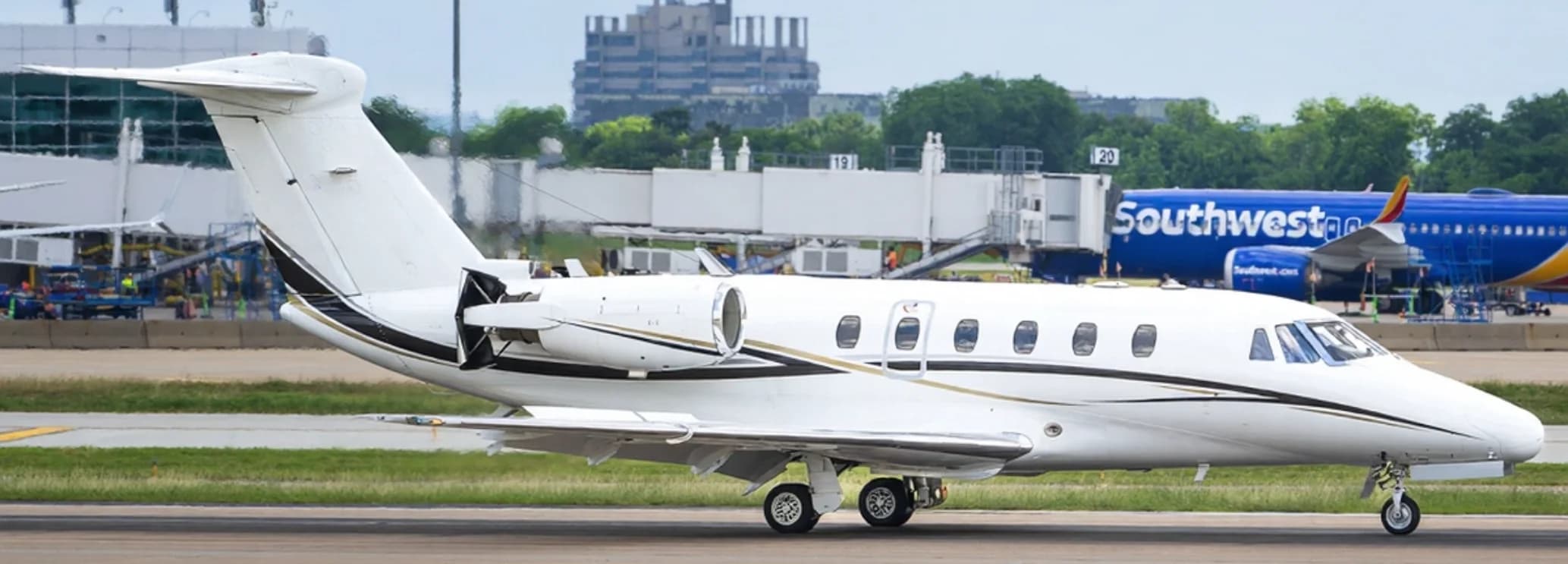
Exterior view of a Cessna Citation III private jet for midsize jet charter

Cessna Citation III

PassengersRangeCruise SpeedCharter FromBest For
Up to 92,070 nm (2,382 mi)468 ktas (539 mph)$3,500/hrExecutive groups needing speed and a 51,000-ft ceiling in the midsize class

Note: The hourly rate is not the total trip cost. Final pricing includes landing and handling fees, crew, overflight permits, and taxes. Variable costs include repositioning, de-icing, wait time, and overnights. Contact Hogani Jets for an accurate all-in quote.

Charter of a Cessna Citation III starts at $3,500 to $5,000 per flight hour. Cessna built the Citation III from 1983 to 1992, 202 aircraft in total. It was the first business jet with a supercritical wing to receive FAA type certification in the United States. It seats up to nine passengers across a 2,070-nautical-mile range at 468 knots. The 51,000-foot service ceiling is among the highest in the midsize category. Hogani Jets coordinates each Citation III charter through licensed Part 135 operators.

At its 1983 introduction, the Citation III was the fastest midsize jet on the market. It also held the longest range in its class at launch. No other midsize jet offered both at once.

The supercritical swept wing made the speed possible. It was the first of its type to receive FAA type certification in the United States. Cessna built an entirely new fuselage for the Citation III. That same cross-section later carried through to the Citation X, Excel, and Sovereign.

The prototype first flew on May 30, 1979. FAA type certification followed on April 30, 1982, after a development program totaling $240 million. Cessna built 202 Citation IIIs between 1983 and 1992.

SpecificationCitation III
ManufacturerCessna/Textron
Aircraft CategoryMidsize jet (twin-engine)
Passenger CapacityUp to 9
Cabin Length17.3 ft (5.27 m)
Cabin Width5.5 ft (1.68 m)
Cabin Height5.7 ft (1.74 m)
Cabin Pressurization7,500 ft cabin altitude
LavatoryEnclosed
Flight AttendantNot typically included
Baggage Capacity62 cu ft
Max Range2,070 nm (2,382 mi)
Max Cruise Speed468 ktas (539 mph)
Service Ceiling51,000 ft
Max Takeoff Weight22,000 lbs
Typical Takeoff Distance~5,030 ft
Typical Landing Distance~2,388 ft
Engines2 x Garrett (Honeywell) TFE731-3B
AvionicsHoneywell SPZ-650 / Collins Pro Line II
Hourly Charter Rate$3,500 to $5,000

The Citation I and II were known as efficient, economical jets. They were not known for speed. Cessna built the Citation III to compete with the fastest midsizers on the market.

The supercritical swept wing was the defining choice. It reduces wave drag at high cruise speeds. That allowed the Citation III to reach performance earlier Citations could not approach. The FAA had never certified a supercritical wing on an American-built aircraft before. The Citation III became the first.

The engines changed too. All earlier Citations ran Pratt & Whitney powerplants. The Citation III switched to Garrett TFE731-3B turbofans, producing 3,650 lbf each. That same engine family later appeared on the Hawker 800XP and many other midsize jets.

The T-tail and elongated fuselage completed the design. Together they created a stable, quiet platform at cruise altitude. The first production aircraft, owned by golfer Arnold Palmer, set a time-to-altitude record of 12 minutes to 39,000 feet.

Most midsize jets reach between 41,000 and 45,000 feet. The Citation III tops out at 51,000 feet, a ceiling more common in super midsize aircraft.

At that altitude, the aircraft operates above commercial airline routes. It sits above most convective weather systems that push turbulence up to 40,000 feet. Thinner, cooler air at 51,000 feet also improves specific range and reduces fuel burn per nautical mile.

Not every Citation III trip reaches that altitude. Route length, weight, and fuel load all determine optimal cruise altitude. But the capability is there and on longer routes it can mean more direct routing with fewer ATC constraints.

The Honeywell SPZ-650 avionics include an Emergency Descent Mode. It activates if cabin pressure is lost above 34,275 feet with the autopilot engaged. The system then descends automatically to 15,000 feet. It was a novel safety feature when the aircraft was certified in 1982.

A midsize jet trades some efficiency for more cabin room, range, and capacity than a light jet provides.

  • More range: 2,070 nautical miles versus 1,100 to 1,900 nm for most light jets.
  • More seats: up to 9 passengers versus 4 to 6 for most light jets.
  • More baggage: 62 cubic feet, one of the largest holds in the midsize class.
  • Better ceiling: 51,000 feet clears virtually all commercial traffic.
  • Best mission: regional and cross-country trips where speed and capacity both matter.

The Citation III seats up to nine passengers. Standard corporate configurations run six to eight seats.

  • A four-seat club section with two forward-facing rear seats is the most common layout. Some configurations add a single or two-seat divan.
  • Cabin height is 5.7 feet; most passengers under approximately 5 feet 8 inches stand fully upright.
  • Passenger seats recline, swivel, and include adjustable armrests and footrests.
  • Headliner lighting and a custom window surround design maximize natural light for an open feel.
  • Trailing link landing gear reduces taxi and landing vibration compared to standard gear on most competing aircraft.
  • A 62-cubic-foot baggage hold accommodates golf clubs, ski equipment, or multiple large suitcases.

The Citation III performs well on regional and cross-country routes where cruise speed matters. Its 2,070-nautical-mile range covers most US domestic city pairs nonstop.

RouteICAO CodesEst. Flight TimeNotes
New York to MiamiKTEB to KMIA~2h 30mWell within comfortable nonstop range
Miami to DallasKMIA to KDAL~2h 30mCross-country business corridor at speed
New York to ChicagoKTEB to KMDW~1h 35mShort regional hop where cruise speed shows
Dallas to AspenKDAL to KASE~1h 50mTrailing link gear handles mountain airport conditions well

Citation III charter rates typically run $3,500 to $5,000 per flight hour, with variation by operator and aircraft equipment. Contact Hogani Jets at charter@hoganijets.com or +1-855-660-0573 for a current quote.

RouteEst. One-Way PriceNotes
New York to Miami$17,000 to $24,600Well within comfortable nonstop range
Miami to Dallas$16,000 to $23,600Cross-country business corridor
New York to Chicago$12,600 to $18,000Short regional hop
Dallas to Aspen$15,500 to $23,300Mountain access with short-field performance

The hourly rate covers core operational costs. Additional fees are quoted separately on every trip.

  • Aircraft operation: fuel, crew, and maintenance are included in the hourly rate.
  • Two certificated pilots: required for all Citation III operations.
  • Federal excise tax and segment fees: federally mandated, quoted separately.
  • Positioning costs: charged if the aircraft must reposition to your departure airport.
  • International handling fees: apply on Caribbean, Canada, and other international flights.

Contact Hogani Jets for current pricing and details.

The most useful comparisons are within the Model 650 family. The Citation VI is the lower-cost variant of the same aircraft. The Citation VII is the more capable, premium variant. All three share the same hourly charter rate tier.

SpecificationCitation VICitation VIICitation III
TypeMidsize jetMidsize jetMidsize jet
Production1991–19951992–20001983–1992
PassengersUp to 9Up to 9Up to 9
Published Range1,890 nm2,300 nm2,070 nm
Cruise Speed468 ktas (539 mph)476 ktas (548 mph)468 ktas (539 mph)
Hourly Rate$3,500 to $5,000$3,500 to $5,000$3,500 to $5,000
Best Use CaseStandard interior at lower purchase costMore range and power; premium cabin standardOriginal 650; the fastest midsize at its introduction

Every Citation III charter operator's Part 135 certificate, insurance coverage, and safety record is independently reviewed before booking. ARGUS, Wyvern, or IS-BAO ratings are considered where they exist as one part of that review.

The Citation III carries Honeywell SPZ-650 integrated avionics with Collins Pro Line II radios and Honeywell Primus 300L weather radar. Its Emergency Descent Mode provides an automated response to cabin decompression above 34,275 feet. Hogani Jets does not operate the aircraft. Every charter is conducted by a licensed Part 135 direct air carrier under that carrier's independent operational control.

The Citation III is a strong fit on business corridors where cruise speed shortens total travel time. The following Hogani Jets route pages cover its most relevant corridors.

RelationshipAircraftWhen to Consider
Upgraded VariantCitation VIIMore powerful engines, longer range, and a premium cabin option
Contemporary AlternativeHawker 800XPWider cabin, nine passengers, and more range from a similar era
Turboprop Value AlternativeBeechcraft King Air 350Lower hourly cost and shorter-field access
Modern Cabin AlternativeCitation XLS Gen2Newer design with updated avionics and a stand-up cabin

Ready to book a Citation III charter or check availability? Contact Hogani Jets for a tailored quote. Call +1-855-660-0573 or email charter@hoganijets.com, and our team will coordinate the right aircraft and operator for your trip.

Reviewed by Matt Hogan — Founder, Hogani Jets & Aviation Specialist.


How much does it cost to charter a Citation III?

Citation III charter rates typically run $3,500 to $5,000 per flight hour, with variation by operator and aircraft equipment. Final cost depends on route, positioning, and season.

What are the differences between the Citation III, Citation VI, and Citation VII?

All three are variants of Cessna's Model 650 and share the same basic airframe. The Citation VI was a lower-cost version of the III with a standard interior and slightly less range. The Citation VII used more powerful TFE731-4R engines, offering higher cruise speed, more range, and a premium cabin option. All three carry up to nine passengers at the same charter rate tier.

How many passengers can a Citation III carry?

The Citation III seats up to nine passengers. Standard corporate configurations seat six to eight.

What is the real range of a Citation III?

Published figures show up to 2,070 nautical miles. Realistic range with a full cabin runs somewhat lower depending on routing, weather, and fuel reserve requirements.

Does the Citation III have a stand-up cabin?

The cabin height is 5.7 feet. Most passengers under approximately 5 feet 8 inches stand fully upright. Taller passengers may need to duck slightly. It is one of the more comfortable cabin heights in the midsize class.

What makes the Citation III historically significant?

The Citation III was the first US-built business jet with a supercritical wing to receive FAA type certification. At introduction, it held the fastest cruise speed and longest range of any midsize jet on the market. The first production aircraft, owned by Arnold Palmer, set a time-to-altitude record of 12 minutes to 39,000 feet.

Are empty leg flights available on the Citation III?

Yes. The Citation III's range and speed create empty-leg opportunities on repositioning flights. Availability is short-notice and date-fixed, so Hogani Jets recommends flexibility when pursuing empty-leg pricing.

Is Hogani Jets a direct air carrier?

No. Hogani Jets is an air charter broker and does not own or operate aircraft. All Citation III charters are facilitated through licensed Part 135 direct air carriers holding full operational and regulatory control.

Last Updated: 21 Sep 2026, 01:15 PM

About Us

Hogani Jets was built on a simple belief: real luxury is quiet, personal, and effortless. We work with a curated list of operators and a small client base so we can give every journey the attention it deserves.

Instant Charter Estimate
compareairCraft1cloud
compareairCraft2cloud

Compare Aircraft

Compare private jet categories side by side, range, cabin, passenger capacity, and hourly cost to find the right aircraft for your mission and route.
https://d2fh6kg71io623.cloudfront.net/uploads/cms/1783689472835_cropped-image.webp

Your Guide: Hogani Jets Uncensored

Hogani Jets Uncensored: Submit your details for your free guide to private jet programs, honest truths, pricing and more.