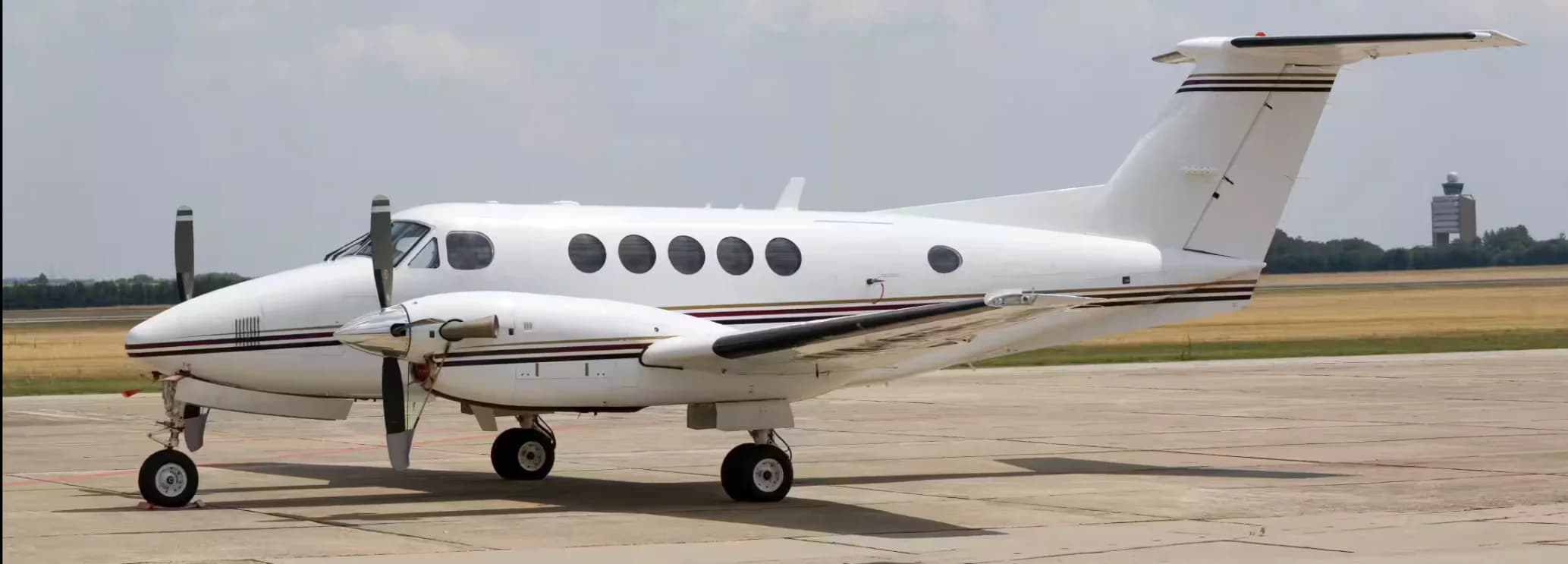
King Air 200 charter aircraft for economical regional private flights

Beechcraft King Air 200

PassengersRangeSpeedCharter FromBest For
Up to 91,580 nm334 mph (290 ktas)$1,300 / hrEconomical regional trips

Note: Please note that the hourly rate is not the total trip cost. Final pricing includes known fees such as landing and handling, crew, overflight permits, and taxes, plus variable costs like repositioning, de-icing, wait time, and overnights. Contact Hogani Jets for an accurate all-in quote.

Hogani Jets coordinates Beechcraft King Air 200 charter flights through licensed Part 135 operators, matching this trusted twin-engine turboprop to economical regional trips and short-field destinations. The King Air 200, and its higher-performance B200 version, is the most well-known and trusted name in the executive turboprop class, with a roomy cabin, twin-engine reliability, and short-field access at a low operating cost. Manufactured by Beechcraft (Textron Aviation), it seats up to 9 passengers with a range of 1,818 miles (1,580 nm) and a cruise speed of 334 mph (290 ktas). King Air 200 charter rates run $1,300 to $1,900 per flight hour, well below light-jet pricing, with one-way trip pricing from roughly $3,500 to $8,500 depending on route. Its strengths are a roomy cabin, twin-engine reassurance, low cost, and short-field capability, not outright speed. The King Air 200 suits travelers who want an economical, proven aircraft for regional trips and access to smaller airports. For a larger cabin, the King Air 350 is the step up; for more speed, a light jet. For a current King Air 200 quote, contact Hogani Jets at charter@hoganijets.com or +1-855-660-0573.

The Beechcraft King Air 200 entered service in 1974 and became the benchmark executive turboprop, with more than 1,700 of the series delivered. It introduced the distinctive T-tail, a greater wingspan, and higher operating weights over the earlier 100 series. The higher-performance B200, introduced in 1981, added more powerful Pratt & Whitney Canada engines, increased cabin pressurization, and updated avionics, and is the most common version in charter today. Powered by two PT6A turboprops, the King Air 200 pairs twin-engine reliability and a roomy cabin with short-field access, at a fraction of a jet's operating cost.

SpecificationKing Air 200 / B200Notes
ManufacturerBeechcraft / Textron AviationIn production since 1974
Aircraft CategoryTurboprop (twin-engine)B200 is the higher-performance version
Passenger CapacityUp to 9Seven to eight typical; two crew
Cabin Length16.6 ft (5.06 m)Roomy double-club cabin
Cabin Width4.5 ft (1.37 m)Comfortable for the class
Cabin Height4.8 ft (1.46 m)Seated comfort for the class
Baggage Capacity54 cu ft (1.5 m³)Accessible in flight
Max Range1,580 nm (2,926 km)Strong range for a turboprop
Max Cruise Speed334 mph (290 ktas)Efficient twin-turboprop cruise
Cabin AltitudePressurized to a comfortable levelB200 increased pressurization
Cabin Noise70 dBAQuieter on later aircraft
EnginesPratt & Whitney Canada PT6A × 2850 shp each; twin-engine
Typical Runway Required~2,900 ft takeoff / 2,300 ft landingShort-field capable
Rate of Climb2,450 ft per minuteStrong climb for the class
Service Ceiling35,000 ftHigh for a turboprop
Hourly Charter Rate$1,300 to $1,900Well below light-jet pricing

The King Air 200 is a turboprop, not a jet, which is why it offers such strong value. Its twin turboprop engines are far more fuel-efficient than jets at lower altitudes and shorter distances, giving a much lower hourly cost, with the trade-off of slower cruise speed. For shorter regional trips, the time difference is small while the cost saving is significant, and it adds the reassurance of two engines.

  • Lower cost: at $1,300 to $1,900 per hour, the King Air 200 runs well below the $2,500 to $3,500 of a light jet.
  • Roomy twin-engine cabin: a comfortable double-club cabin with two engines for added redundancy.
  • Short-field access: it operates from runways around 2,900 feet, opening many smaller regional airports.
  • Slower cruise: at 290 ktas it is slower than a light jet, so the time difference is modest on shorter trips.

Buyers cross-shopping the King Air 200 will see both the original 200 and the higher-performance B200. They share the same airframe and roomy cabin. The B200 added more powerful engines, increased pressurization, and updated avionics, and is the most common charter version. This comparison shows the differences.

SpecificationKing Air 200King Air B200
Years Built1974 to 19811981 to present
EnginesPT6A-41PT6A-42 (more powerful)
PressurizationStandardIncreased differential
AvionicsOriginalUpdated; later Pro Line 21
CabinRoomy double-clubSame, refined on later builds
Hourly Rate$1,300-$1,900$1,300-$1,900
CharacterOriginal executive turbopropRefined, most common version

For charter, the great majority of available aircraft are the B200, the refined and more capable version. Both share the same roomy cabin and fly the same routes at the same rate, with the B200 offering better performance and pressurization.

The King Air 200 has a roomy double-club cabin that many passengers find as comfortable as a light jet, seating up to 9. With a quiet, pressurized interior and a low operating cost, it has been a favorite for executive and regional travel for decades.

  • The double-club cabin seats up to 9, with seven to eight typical, with worktables and comfortable seating for productive travel.
  • Electronically tuned vibration absorbers and noise control keep the cabin quiet, especially on later aircraft.
  • Baggage capacity of 54 cubic feet is accessible in flight and handles luggage and gear for the group.
  • A private lavatory is standard, and later aircraft add satellite communications and Wi-Fi. Confirm amenities at booking.

Note: Baggage note for the King Air 200: The 54 cubic foot hold, accessible in flight, comfortably handles luggage and gear for up to nine passengers. For a larger cabin, the King Air 350 is the step up.

The King Air 200 performs well on economical regional routes within its 1,580nm range, especially where short runways matter. These represent its most common charter missions.

RouteICAO CodesEst. TimeNotes
Houston to New OrleansKHOU to KNEW~1h 10mQuick Gulf Coast business run.
Los Angeles to Las VegasKVNY to KLAS~1h 15mEconomical Western hop.
Philadelphia to BostonKPNE to KBED~1h 20mEast Coast regional run.
Chicago to MinneapolisKPWK to KFCM~1h 30mMidwest business run.
Miami to the BahamasKOPF to MYEH~1hShort-field island access.

Note: The King Air 200 is at its best on economical regional trips, especially to smaller airports. On longer or faster trips a light jet is preferable, and for a larger cabin the King Air 350 is the step up.

King Air 200 charter rates run $1,300 to $1,900 per flight hour, well below light-jet pricing and strong value for a roomy twin-engine aircraft. Total one-way trip pricing depends on route distance, positioning, and demand.
For a current King Air 200 quote, contact Hogani Jets at charter@hoganijets.com or +1-855-660-0573.

Note: Please note that the hourly rate is not the total trip cost. Final pricing includes known fees such as landing and handling, crew, overflight permits, and taxes, plus variable costs like repositioning, de-icing, wait time, and overnights. Contact Hogani Jets for an accurate all-in quote.

RouteEst. One-Way PriceNotes
Houston to New Orleans$4,500 - $5,800Quick Gulf Coast run.
Los Angeles to Las Vegas$4,500 - $5,800Economical Western hop.
Philadelphia to Boston$4,500 - $5,800East Coast regional run.
Chicago to Minneapolis$5,000 - $6,500Midwest business run.
Miami to the Bahamas$4,500 - $6,400Short-field island access.

The $1,300 to $1,900 hourly rate for a King Air 200 charter covers core operational costs. Additional fees and services are quoted separately on every trip, which is important to understand when comparing total trip prices.

  • Aircraft operation: fuel, crew, and maintenance are included in the hourly rate.
  • Two certificated pilots: standard for King Air 200 charter operations.
  • Federal excise tax and segment fees: federally mandated, quoted separately.
  • Positioning costs: charged if the aircraft must reposition to your departure airport.
  • International handling fees: these apply on Bahamas and other international hops.

Contact Hogani Jets for current pricing and more details about King Air private jet.

When buyers cross-shop the King Air 200, the most common comparisons are the King Air 350, its larger sibling, and the Pilatus PC-12, a single-engine turboprop. The 200 is the economical twin-engine choice; the 350 adds cabin, the PC-12 single-engine efficiency. The table below shows where each fits.

SpecificationKing Air 200King Air 350Pilatus PC-12
TypeTwin-engine turbopropTwin-engine turbopropSingle-engine turboprop
PassengersUp to 9Up to 11Up to 9
Range1,580 nm1,806 nm1,845 nm
Cruise Speed334 mph (290 ktas)357 mph (310 ktas)311 mph (270 ktas)
CabinRoomy double-clubLargest, stretchedRoomy, flat floor
Hourly Rate$1,300-$1,900$1,600-$2,200$1,300-$1,900
Best Use CaseTurboprop. Economical twinTurboprop. Most cabin, groupsTurboprop. Single-engine value

The King Air 200 is most frequently chartered on economical regional routes. Links below connect to relevant route and destination pages.

  • Miami to the Bahamas: short-field island access.
  • Miami to Nassau, Bahamas: a quick island hop.
  • New York to Miami: best flown on a faster light jet for this distance.
  • Bahamas private jet charter:  a popular King Air destination region.

Hogani Jets coordinates each King Air 200 charter through licensed Part 135 operators. Hogani Jets does not operate the aircraft directly. Every charter is conducted by a licensed Part 135 direct air carrier whose crew, maintenance, and operations remain under that carrier's independent operational control, with certifications and safety records reviewed as part of every booking.

RelationshipAircraftWhen to Consider
Larger SiblingKing Air 350Stretched King Air with a larger cabin and more range.
Single-Engine TurbopropPilatus PC-12 Roomy single-engine turboprop at a similar rate.
Fast TurbopropDaher TBM 960 Faster single-engine turboprop for smaller groups.
Utility TurbopropCessna Caravan Rugged short-field utility prop for remote strips.
Entry Light JetCitation CJ2 Step up to jet speed for faster or longer trips.

Ready to book King Air 200 private jet or want to check availability? Contact Hogani Jets for a customized King Air 200 or B200 quote. Call +1-855-660-0573 or email charter@hoganijets.com, and our team will coordinate the right aircraft and operator for your trip.

Reviewed by Matt Hogan — Founder, Hogani Jets & Aviation Specialist.

How much does it cost to charter a King Air 200?

King Air 200 and B200 charter rates run $1,300 to $1,900 per flight hour, well below light-jet pricing. One-way trip pricing ranges from about $3,500 for short hops to $8,500 for longer runs. Pricing varies by route, positioning, and season.

What is the difference between the King Air 200 and B200?

The B200 is the higher-performance version, introduced in 1981. It shares the same airframe and roomy cabin as the original 200, while adding more powerful engines, increased pressurization, and updated avionics. The B200 is the most common version in charter service today, and both fly the same routes at the same rate.

Why charter a King Air 200 instead of a jet?

The King Air 200 costs far less per hour than a light jet while offering a roomy cabin, twin-engine reassurance, and access to short runways. On shorter regional trips, the speed difference is small while the cost saving is significant, which makes it one of the best values in private aviation.

How many passengers can the King Air 200 carry?

The King Air 200 seats up to 9 passengers, with seven to eight typical in a comfortable double-club layout. Its roomy cabin makes it well suited to regional business and group travel.

Can the King Air 200 use short runways?

Yes. The King Air 200 operates from runways around 2,900 feet, with rugged landing gear suited to shorter and less-prepared fields. This opens many smaller regional airports that jets cannot use.

What is the range of the King Air 200?

The King Air 200 has a range of 1,580 nautical miles (1,818 miles), strong for a turboprop. It is best on economical regional trips. For a larger cabin, the King Air 350 is the step up; for faster or longer trips, a light jet is the better fit.

Is the King Air 200 still available for charter?

Yes. With more than 1,700 of the series delivered, the King Air 200 and B200 are among the most widely available charter turboprops in the world, valued for their roomy cabin, twin-engine reliability, and low operating cost.

Is Hogani Jets a direct air carrier?

No. Hogani Jets is an air charter broker and does not own or operate aircraft. All King Air 200 charters are facilitated through licensed Part 135 direct air carriers, who maintain full operational control and regulatory compliance for every flight.

About Us

Hogani Jets was built on a simple belief: real luxury is quiet, personal, and effortless. We work with a curated fleet and a small client base so we can give every journey the attention it deserves.

Instant Charter Estimate
compareairCraft1cloud
compareairCraft2cloud

Compare Aircraft

Compare private jet categories side by side, range, cabin, passenger capacity, and hourly cost to find the right aircraft for your mission and route.
https://d2fh6kg71io623.cloudfront.net/uploads/cms/1783689472835_cropped-image.webp

Your Guide: Hogani Jets Uncensored

Hogani Jets Uncensored: Submit your details for your free guide to private jet programs, honest truths, pricing and more.