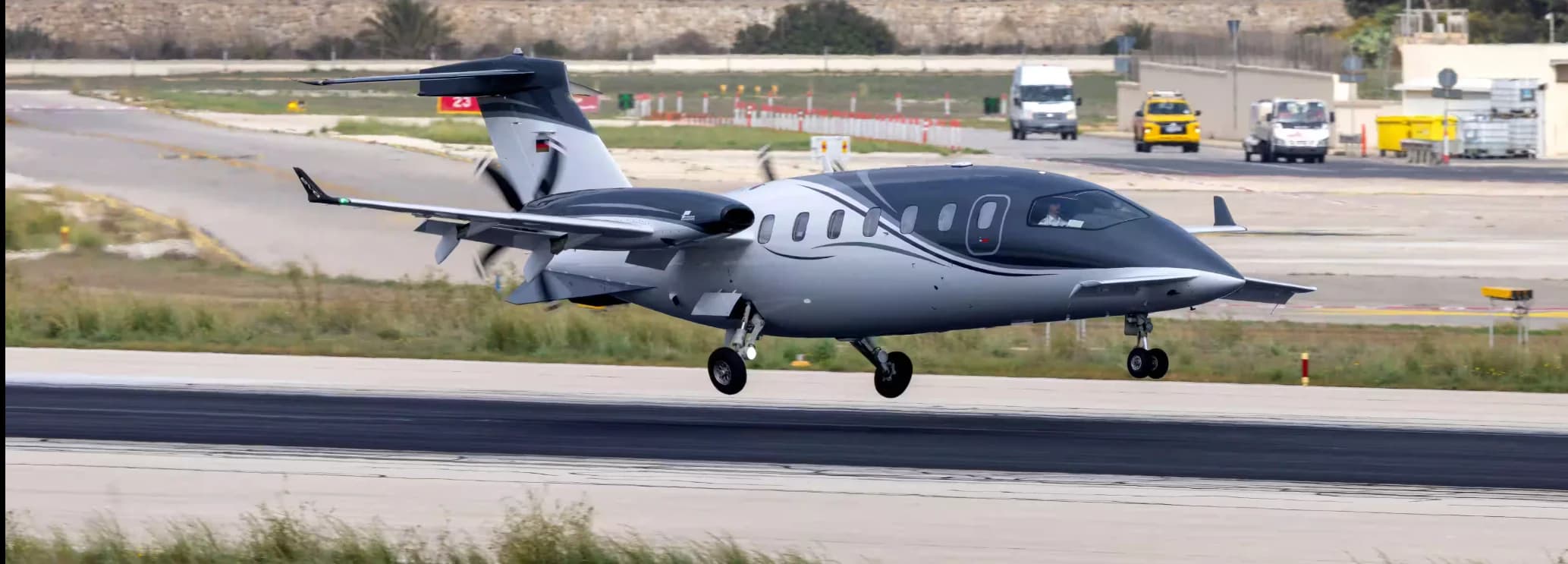
Piaggio Avanti EVO twin-engine turboprop on the tarmac, showcasing its distinctive pusher-prop design, five-blade scimitar propellers, and spacious stand-up cabin.

Piaggio Avanti EVO

PassengersRangeCruise SpeedCharter FromBest For
Up to 81,620 nm (1,864 mi)402 ktas (462 mph)$3,000/hrGroups wanting the quietest, fastest Avanti generation

Note: The hourly rate is not the total trip cost. Final pricing includes landing and handling fees, crew, overflight permits, and taxes, plus variable costs such as repositioning, de-icing, wait time, and overnights. Contact Hogani Jets for an accurate all-in quote.

Charter of a Piaggio Avanti EVO starts at $3,000 to $3,800 per flight hour. Built by Piaggio Aerospace since 2014, the EVO is the third generation of the P.180 line, following the original Avanti and the Avanti II. Five-blade scimitar propellers reduce cabin noise further than earlier generations, and the cabin reaches a genuine stand-up height. It seats up to nine passengers with a range of 1,620 nautical miles and a 402-knot cruise speed. Hogani Jets coordinates each Avanti EVO charter through licensed Part 135 operators.

Piaggio Aerospace calls this the third generation of the P.180 for a reason. The EVO keeps the family's unmistakable three-surface shape but refines nearly everything else.  In its native Italy, the aircraft has earned the nickname Ferrari of the skies. Five-blade scimitar propellers are the most visible change. They matter more than they might look.

Piaggio Aerospace has built the EVO since 2014. It is the third generation of the P.180 line after the original Avanti and the Avanti II. Five-blade scimitar propellers and a genuine stand-up cabin define this generation.

SpecificationPiaggio Avanti EVONotes
ManufacturerPiaggio AerospaceProduced 2014 to present; third generation of the P.180
Aircraft CategoryTurboprop (twin-engine)Five-blade scimitar propellers, unique to this generation
Passenger CapacityUp to 86 to 7 typical in a comfortable executive layout
Cabin Length18.6 ftConfirm with your operator; some published sources cite a shorter cabin
Cabin Width6.1 ft (1.86 m)Wider than most turboprop competitors
Cabin Height5.8 ft (1.77 m)A genuine stand-up cabin for most passengers
Cabin Pressurization6,000 ft cabin altitudeGenuinely pressurized
LavatoryEnclosedCompact rather than palatial; no separate galley space
Baggage Capacity~60 cu ftExternal compartment; confirm capacity for larger loads at booking
Max Range1,620 nm (1,864 mi)Realistic range with passengers often runs somewhat lower
Max Cruise Speed402 ktas (462 mph)Among the fastest cruise speeds of any turboprop
Service Ceiling41,000 ftHigher than most turboprops, closer to light jet territory
Typical Takeoff Distance~2,740 ftShort-field capable despite its speed
Typical Landing Distance~2,300 ftVaries with passenger load and fuel
Propellers5-blade scimitarUnique to the EVO; reduces noise and vibration further
Hourly Charter Rate$3,000 to $3,800The highest rate in the Avanti family, reflecting its speed and quiet

Three genuinely different aircraft share the Avanti name. Knowing which one an operator is quoting matters, since specs and pricing differ meaningfully across generations.

SpecificationPiaggio Avanti (Original)Piaggio Avanti IIPiaggio Avanti EVO
Production Years1990 to 20052005 to 20142014 to present
EnginesPT6A-66PT6A-66BPT6A-66B
PropellersStandard 4-bladeStandard 4-blade5-blade scimitar
AvionicsThree-screen Collins EFISRockwell Collins Pro Line 21Rockwell Collins Pro Line 21
Cabin Standing RoomNear stand-upNear stand-upGenuine stand-up height
Max Cruise SpeedBelow Avanti II speeds398 ktas (458 mph)402 ktas (462 mph)
Max Range1,500 nm1,730 nm1,620 nm
Hourly Rate$2,200 to $2,700$2,500 to $2,900$3,000 to $3,800

The Avanti II replaced uprated PT6A-66 engines with the more powerful PT6A-66B. It also swapped the original's three-screen Collins EFIS for Rockwell Collins Pro Line 21 avionics. The airframe and cabin design stayed the same; the engine and cockpit did not.

The uprated PT6A-66B engine is the entire reason. More power from the same airframe translates directly into a higher cruise speed. The aircraft's shape and cabin stayed the same.

The EVO's headline change is its five-blade scimitar propeller, replacing the standard propeller used on both earlier generations. This refinement further reduces cabin noise and vibration beyond what the Avanti II already achieved.

Marginally. Both use the same PT6A-66B engine. The EVO's propeller and aerodynamic refinements push cruise speed slightly higher, from 398 to 402 knots.

The EVO is the first to offer genuine stand-up height for most passengers. The original Avanti and the Avanti II both come close. Both are typically described as near stand-up rather than a full stand-up cabin.

Yes. All three share the same three-lifting-surface layout: a forward canard, a main wing, and a tailplane. Engines mount behind the cabin, driving pusher propellers. Each generation refines the engine, avionics, or propeller without changing this core design.

The EVO's hourly rate reflects its refinements: the quietest cabin, the fastest cruise, and genuine stand-up height. Those upgrades come at a premium over the earlier generations.

Independent test-flight reporting on the EVO is candid about one thing: the lavatory is compact. There is no separate galley space either.

Neither limitation affects the EVO's core strengths: cabin quiet, cruise speed, and genuine stand-up height for most passengers.

A turboprop typically trades a light jet's cruise speed for a lower hourly rate. The EVO narrows that gap further than any other turboprop in the Avanti family.

  • Lower cost: $3,000 to $4,200 per hour, still competitive with entry light jets on a per-hour basis.
  • Closer cruise speed: 402 knots versus 480 knots or faster for a light jet, a narrow gap here.
  • Genuine stand-up cabin: unusual for a turboprop of any generation.
  • Best mission: fast regional trips for 4 to 7 passengers wanting the quietest, most refined Avanti available.

The EVO seats up to eight passengers, typically six to seven in a comfortable executive configuration.

  • A four-seat club section plus a forward divan is a common layout for charter use.
  • Genuine stand-up height sets this generation apart from the original Avanti and the Avanti II.
  • Five-blade scimitar propellers make this the quietest cabin in the Avanti family.
  • The enclosed lavatory is compact; there is no separate galley space.

The EVO performs best on fast regional routes where its cruise speed and cabin quiet matter alongside cost.

RouteICAO CodesEst. Flight TimeNotes
New York to ChicagoKTEB to KMDW~1h 40mFast regional business corridor
Los Angeles to DenverKVNY to KDEN~1h 35mHigh-elevation destination
Miami to the BahamasKOPF to MYNN~30mShort international leg
Dallas to NashvilleKDAL to KBNA~1h 30mRegional business route

Piaggio Avanti EVO charter rates run $3,000 to $3,800 per flight hour, the highest in the Avanti family. Total one-way trip pricing depends on route distance, positioning, and demand. 

Contact Hogani Jets at charter@hoganijets.com or +1-855-660-0573 for a current quote.

RouteEst. One-Way PriceNotes
New York to Chicago$10,400 to $16,000Fast regional business corridor
Los Angeles to Denver$12,800 to $18,700High-elevation destination
Miami to the Bahamas$8,800 to $12,500Short international leg
Dallas to Nashville$13,600 to $19,400Regional business route

The $3,000 to $3,800 hourly rate covers core operational costs. Additional fees are quoted separately on every trip.

  • Aircraft operation: fuel, crew, and maintenance are included in the hourly rate.
  • Two certificated pilots: standard for Avanti EVO charter operations.
  • Federal excise tax and segment fees: federally mandated, quoted separately.
  • Positioning costs: charged if the aircraft must reposition to your departure airport.
  • International handling fees: apply on Caribbean, Canada, and other international hops.

Contact Hogani Jets for current pricing and details.

Every Piaggio Avanti EVO charter operator's Part 135 certificate, insurance coverage, and safety record is independently reviewed before booking. 

The EVO's unusual design requires specialized pilot training, and it flies with two certificated pilots in charter service. Hogani Jets does not operate the aircraft. 

Every charter is conducted by a licensed Part 135 direct air carrier under that carrier's independent operational control.

The EVO is a strong fit on fast regional legs where cruise speed and cabin quiet matter most. The following Hogani Jets route pages cover its most relevant charter corridors.

RelationshipAircraftWhen to Consider
PredecessorPiaggio Avanti IIThe prior generation at a lower hourly rate
Original ModelPiaggio AvantiThe first generation, at the lowest hourly rate in the family
Single-Engine Speed AlternativeEpic E1000Comparable cruise speed from a single-engine design
Twin-Engine Value AlternativeBeechcraft King Air 350More seats and cabin room at a lower hourly rate

Ready to book a Piaggio Avanti EVO charter or check availability? Contact Hogani Jets for a tailored quote. Call +1-855-660-0573 or email charter@hoganijets.com, and our team will coordinate the right aircraft and operator for your trip.

Reviewed by Matt Hogan — Founder, Hogani Jets & Aviation Specialist.


How much does it cost to charter a Piaggio Avanti EVO?

Piaggio Avanti EVO charter rates run $3,000 to $3,800 per flight hour, the highest in the Avanti family. One-way trip pricing ranges from about $7,800 for short international hops to $15,000 or more on longer legs.

What is the difference between the Avanti EVO and the Avanti II?

The EVO adds five-blade scimitar propellers over the Avanti II's standard propeller, reducing cabin noise further. It also achieves genuine stand-up cabin height, while the Avanti II is described as near stand-up.

Why is the Piaggio Avanti EVO called the 'Ferrari of the skies'?

It is a nickname earned in Italy, reflecting the aircraft's distinctive styling and strong turboprop performance.

How many passengers can the Piaggio Avanti EVO carry?

The EVO seats up to nine passengers, typically six to seven in a comfortable configuration. A common layout is a four-seat club plus a forward divan.

Does the Piaggio Avanti EVO have a stand-up cabin?

Yes. The EVO is the first Avanti generation with genuine stand-up height for most passengers. The earlier Avanti and Avanti II are both described as near stand-up.

How fast does the Piaggio Avanti EVO fly?

The EVO cruises at up to 402 knots true airspeed (462 mph). That is slightly faster than the Avanti II, and among the fastest cruise speeds of any turboprop.

Are empty leg flights available on the Piaggio Avanti EVO?

Yes. The Piaggio Avanti EVO's regional positioning creates empty-leg opportunities at meaningful savings off standard one-way rates. Availability is short-notice and date-fixed, so Hogani Jets recommends flexibility when chasing empty-leg pricing.

Is Hogani Jets a direct air carrier?

No. Hogani Jets is an air charter broker and does not own or operate aircraft. All Piaggio Avanti EVO charters are facilitated through licensed Part 135 carriers, holding full operational and regulatory control.

Last Updated: 23 Sep 2026, 12:32 PM

About Us

Hogani Jets was built on a simple belief: real luxury is quiet, personal, and effortless. We work with a curated list of operators and a small client base so we can give every journey the attention it deserves.

Instant Charter Estimate
compareairCraft1cloud
compareairCraft2cloud

Compare Aircraft

Compare private jet categories side by side, range, cabin, passenger capacity, and hourly cost to find the right aircraft for your mission and route.
https://d2fh6kg71io623.cloudfront.net/uploads/cms/1783689472835_cropped-image.webp

Your Guide: Hogani Jets Uncensored

Hogani Jets Uncensored: Submit your details for your free guide to private jet programs, honest truths, pricing and more.