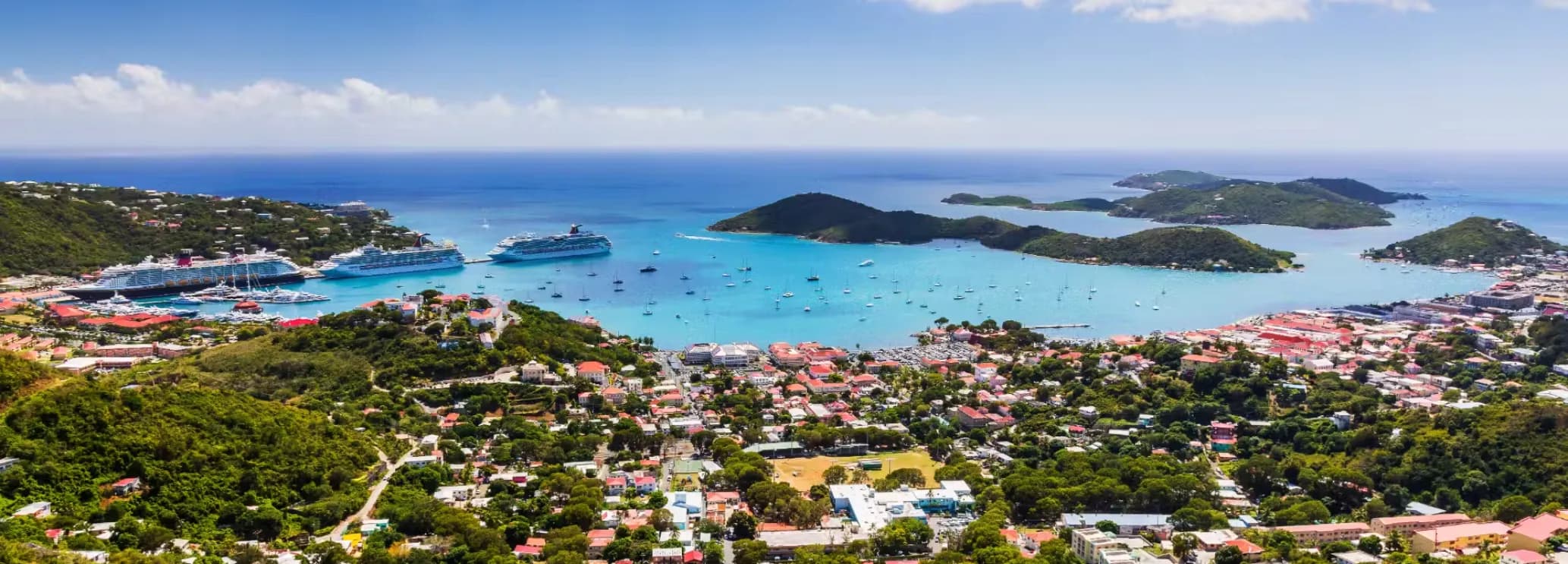
Private Jet Charter to St. Thomas, U.S. Virgin Islands
Private jet charter to St. Thomas starts at $17,000+ one way, with flights from Miami averaging about 2.5 to 3 hours and New York routes about 4 to 5 hours. Aircraft operate into Cyril E. King Airport (TIST / STT), a towered international airport whose 7,000 ft (2,134 m) Runway 10/28 supports turboprops, light, midsize, and super midsize jets under standard conditions, with heavy and ultra-long-range jets feasible on operational review. It has an ILS approach, full FBO services, and U.S. Customs and Border Protection on site. St. Thomas is the main gateway to the U.S. Virgin Islands and a leading Caribbean luxury destination. Hogani Jets coordinates each charter through licensed Part 135 operators.
St. Thomas is the main gateway to the U.S. Virgin Islands and one of the most popular luxury destinations in the Caribbean. As a U.S. territory, it offers the rare combination of a genuine Caribbean island with no passport requirement for U.S. citizens and a full-service international airport. Cyril E. King Airport is a towered field with an instrument approach, full FBO services, and U.S. Customs on site, which makes St. Thomas one of the most operationally straightforward luxury arrivals in the region.
A Full-Service International Gateway
Unlike the remote Out Islands, St. Thomas has a high-capacity international airport with consistent traffic, strong aircraft availability, and three established FBOs. The 7,000 ft runway supports turboprops through super midsize jets without restriction, with heavy and ultra-long-range jets feasible on operational review. This makes it a flexible destination for everything from a light jet from South Florida to a heavy jet from the Northeast or beyond.
No Passport Needed for U.S. Travelers
As a U.S. territory, St. Thomas requires no passport for U.S. citizens, and arrivals are handled through U.S. Customs and Border Protection. This removes the international-arrival friction of the foreign Caribbean and is a major reason the island sees such high private aviation volume from the U.S. mainland.
Luxury Resorts and Cruise-Crossover Appeal
St. Thomas combines a deep luxury-resort market, world-class beaches like Magens Bay, and the duty-free shopping of Charlotte Amalie. It is also a major cruise port, which drives strong year-round visitor demand and a high volume of luxury and crossover travel. For private clients, it is a polished, high-capacity destination with genuine market depth.
St. Thomas is served by a single international airport, Cyril E. King, which handles all private aviation traffic with full FBO and customs infrastructure.
| Airport | ICAO / IATA | Runway | Notes |
|---|---|---|---|
| Cyril E. King (PRIMARY) | TIST / STT | 7,000 ft (2,134 m) Rwy 10/28, Grooved Asphalt | The international gateway to St. Thomas. Towered, with an ILS approach and a strong PCR 790 pavement. Supports turboprops through super midsize jets under standard conditions, heavy and ULR jets on operational review. U.S. Customs and Border Protection on site. FBOs: Standard Aviation, Execujet, St. Thomas Jet Center (Signature). |
Cyril E. King (TIST) is a full-service international airport, towered with an ILS approach, strong pavement, three FBOs, and U.S. Customs on site. It is far more capable than the remote-island fields, the operational consideration is the terrain-influenced approach rather than the runway or pavement, which is why the largest jets operate on operational review.
St. Thomas has three established FBOs at Cyril E. King, with U.S. Customs and Border Protection on site, far more infrastructure than any Out Island field. The Standard Aviation hangar handles aircraft up to G700 and Global 8000 size.
FBO | Notes |
|---|---|
| Full-service FBO with a hangar that handles large-cabin aircraft up to G700 and Global 8000 size. Fuel, customs coordination, and concierge handling. | |
Execujet | Established FBO providing fueling, ground handling, and customs coordination for private arrivals. |
St. Thomas Jet Center (Signature) | Signature-affiliated FBO with full handling, fuel, and concierge services at TIST. |
Yes. Private jets fly nonstop into Cyril E. King from across the U.S. and the Caribbean. As a U.S. territory, St. Thomas requires no passport for U.S. citizens, and arrivals are processed through U.S. Customs and Border Protection. The ATC tower currently operates approximately 7:00 AM to 9:30 PM. Runway availability and after-hours operations should be confirmed during trip planning; STT currently has scheduled nightly runway closures from 10:00 PM to 5:00 AM through December 31, 2026.
Nonstop Routes Into St. Thomas (TIST)
- Miami and Fort Lauderdale: approximately 2.5 to 3 hours by light, midsize, or super midsize jet. The primary departure market.
- New York and Teterboro: approximately 4 to 5 hours by midsize or super midsize jet.
- Atlanta: approximately 3.5 to 4 hours by midsize or super midsize jet.
- Chicago: approximately 4.5 to 5 hours by super midsize jet.
- San Juan: approximately 30 to 45 minutes by turboprop or light jet, a common regional leg.
St. Thomas supports direct point-to-point operations across short-haul, transcontinental, and long-range routes. The 7,000 ft runway and strong pavement handle the full aircraft range; the terrain-influenced approach is the planning factor for the largest cabins, which operate on operational review.
Cyril E. King operates a 7,000 ft (2,134 m) grooved-asphalt runway (10/28) with an ILS approach and a strong PCR 790 pavement rating. The runway and pavement comfortably support the full charter range. The genuine planning consideration at St. Thomas is the terrain-influenced approach, the island is mountainous and the Runway 10 approach has documented visual-illusion cautions, so the largest jets operate on operational review rather than because of any runway limit.
Aircraft Feasibility at TIST
| Aircraft Category | Passengers | Feasibility | Operational Notes |
|---|---|---|---|
| Executive Turboprop | 4–10 | Fully feasible | King Air 350, Pilatus PC-12. Efficient for San Juan and regional Caribbean legs. |
| Light Jet | 6–9 | Fully feasible | Citation CJ3, Phenom 300. Common from South Florida. |
| Midsize Jet | 8–9 | Fully feasible | Citation XLS+, Hawker 800XP. Comfortable from the East Coast. |
| Super Midsize Jet | 8–10 | Fully feasible | Challenger 300, Challenger 350. Strong from New York, Atlanta, Chicago. |
| Heavy Jet | 12–19 | Feasible with operational review | Gulfstream G450, Challenger 605. Supported by pavement and runway; the terrain-influenced approach warrants a review. |
| Ultra-Long-Range Jet | 16–19 | Feasible with operational review | G650, Global 7500. For long-haul and international routing, on operational review for the approach. |
St. Thomas comfortably handles turboprops through super midsize jets without restriction. Heavy and ultra-long-range jets are feasible on operational review, the limiting factor is the terrain-influenced approach, not the runway or pavement, which are strong. The Standard Aviation hangar at TIST handles aircraft up to G700 and Global 8000 size. Passenger figures shown are maximum capacity; typical configurations carry fewer.
Flight Logistics and Arrival Planning
St. Thomas is a U.S. territory arrival processed through CBP, with full FBO handling. Planning is straightforward thanks to the towered airport, ILS approach, and established ground infrastructure. Pre-departure documentation and arrival handling are coordinated ahead of each flight through the Part 135 operators Hogani Jets works with.
- U.S. citizens need no passport; arrivals and U.S.-mainland departures are processed through U.S. Customs and Border Protection on site.
- Three FBOs (Standard Aviation, Execujet, St. Thomas Jet Center) provide fueling, customs coordination, and concierge handling.
- The tower operates roughly 0700 to 2300; the ILS approach to Runway 10 supports reliable arrivals, with the terrain-influenced approach planned by the operating crew.
- Ground transfer to Charlotte Amalie and the resorts is short; St. John, Water Island, and the BVI are reached by coordinated ferry or inter-island transfer.
St. Thomas's capable runway and strong infrastructure allow the full spectrum of charter aircraft. Cruise speed is included below as a planning reference and matters on the longer transcontinental routes. Light and midsize jets suit South Florida; midsize through heavy jets cover the Northeast and beyond.
| Category | Example Aircraft | Passengers | Cruise Speed | Range | Recommended Use |
|---|---|---|---|---|---|
| Light Jet | Citation CJ3, Phenom 300 | 6–9 | ~480-521 mph | ~1,875 nm | South Florida routes |
| Midsize Jet | Citation XLS+, Hawker 800XP | 8–9 | ~506-514 mph | ~2,100 nm | East Coast and mid-Atlantic |
| Super Midsize | Challenger 300, Challenger 350 | 8–10 | ~541 mph | ~3,100-3,200 nm | New York, Atlanta, Chicago |
| Heavy Jet | Gulfstream G450, Challenger 605 | 12–19 | ~528-548 mph | ~4,000-4,350 nm | Long-range and international, on review |
Because St. Thomas accepts the full aircraft range, group size and route distance drive the choice, with the terrain-influenced approach the planning factor for the largest cabins. The FBOs at TIST routinely handle large-cabin and ultra-long-range aircraft.
St. Thomas charter traffic is led by the U.S. East Coast, with strong demand from South Florida and the Northeast, plus quick regional legs from San Juan. The runway and infrastructure support direct routing across all of them.
| Route | Distance | Flight Time | Best Aircraft Category |
|---|---|---|---|
| Miami (KOPF) to St. Thomas (TIST) | ~1,100 mi / 956 nm | ~2h 30m to 3h | Light, Midsize, or Super Midsize Jet |
| Fort Lauderdale (KFXE) to St. Thomas | ~1,080 mi / 939 nm | ~2h 30m to 3h | Light or Midsize Jet |
| New York (KTEB) to St. Thomas | ~1,610 mi / 1,400 nm | ~4h to 5h | Midsize or Super Midsize Jet |
| Atlanta (KPDK) to St. Thomas | ~1,500 mi / 1,303 nm | ~3h 30m to 4h | Midsize or Super Midsize Jet |
| San Juan (TJSJ) to St. Thomas | ~75 mi / 65 nm | ~30 to 45 min | Turboprop or Light Jet. Regional leg |
Private jet charter to St. Thomas starts at $17,000+ one way for a light or midsize jet from South Florida, rising with distance and aircraft size to super midsize and heavy jets from the Northeast and long-range origins. All prices are starting points; the final quote reflects the specific aircraft and schedule.
| Route | Aircraft | One-Way Price | Passengers | Flight Time |
|---|---|---|---|---|
| Miami to St. Thomas | Light / Midsize Jet | $17,000+ | Up to 10 | ~2h 30m to 3h |
| Fort Lauderdale to St. Thomas | Light / Midsize Jet | $17,000+ | Up to 10 | ~2h 30m to 3h |
| New York to St. Thomas | Midsize / Super Midsize | $35,000+ | Up to 10 | ~4h to 5h |
| Atlanta to St. Thomas | Midsize / Super Midsize | $39,000+ | Up to 10 | ~3h 30m to 4h |
| Long-range / international | Heavy / ULR Jet | $70,000+ | Up to 19 | Varies |
Prices reflect standard one-way charter starting rates including flight time, repositioning, fuel, crew, taxes, and handling. Long-haul and international charters are quoted individually. Final pricing depends on the specific aircraft, date, and availability.
Contact Hogani Jets at charter@hoganijets.com or +1-855-660-0573 for a current quote.
Hourly Charter Rates by Aircraft Category
One-way charter prices include flight time plus repositioning, fuel, crew, taxes, and handling. The hourly rates below show the underlying cost per flight hour for each aircraft category.
| Aircraft Category | Hourly Rate | Example Aircraft |
|---|---|---|
| Turboprop | $1,100 – $2,300/hr | King Air 350, Pilatus PC-12 |
| Light Jet | $2,300 - $3,800/hr | Citation CJ3, Phenom 300 |
| Midsize Jet | $2,800 - $5,500/hr | Citation XLS+, Hawker 800XP |
| Super Midsize Jet | $4,500 - $7,000/hr | Challenger 300, Challenger 350 |
| Heavy Jet | $5,500 - $8,000/hr | Gulfstream G450, Challenger 605 |
| Ultra-Long-Range Jet | $8,000 - $20,000/hr | Gulfstream G650, Global 7500 |
Pricing Factors Specific to St. Thomas
- The capable runway and strong infrastructure support a wide aircraft range, so pricing spans light jets through heavy and ULR aircraft by route.
- High traffic volume and three FBOs improve aircraft availability and reduce repositioning exposure compared with remote destinations.
- U.S. territory status means CBP processing rather than foreign customs, which simplifies handling, though landing fees apply.
- Long-haul routes from the Northeast, Midwest, and internationally drive the upper pricing tiers through fuel and crew cost.
St. Thomas operates year-round, with Caribbean weather and resort demand shaping the calendar.
- Peak season (December through April): Best weather and highest luxury-resort demand. Book 3 to 6 weeks ahead, more for the holidays.
- Shoulder season (May and November): Favorable conditions with pricing below peak. A strong value window.
- Hurricane season (June through October): Meaningful Caribbean weather risk, particularly August and September. Flexible scheduling is important; the high traffic volume aids rebooking.
- Cruise-season crossover: St. Thomas is a major cruise port, so resort areas and Charlotte Amalie are busiest when ships are in; private clients often plan around port days.
This guide is written for travelers arriving by private jet. The focus is on the arrival sequence, where to stay, and the beaches, resorts, and experiences that define St. Thomas.
Where to Stay on St. Thomas
St. Thomas has a genuine luxury-resort market, unlike the remote Out Islands, with a strong set of internationally branded properties. The three below are the leading choices for private jet clients, all a short transfer from the airport.
| Hotel / Resort | Setting | Category | Notes |
|---|---|---|---|
| The Ritz-Carlton, St. Thomas | East End | Luxury Resort | The island's flagship luxury resort, set on a private beach on the east end with a marina, spa, and full amenities. The standout choice for luxury travelers. |
| Frenchman's Reef Resort (Autograph Collection) | Near Charlotte Amalie | Luxury Resort | A recently rebuilt landmark resort overlooking the harbour, with multiple pools, dining, and a private beach. A polished, full-service base close to town. |
| The Westin Beach Resort & Spa at Frenchman's Reef | Near Charlotte Amalie | Resort & Spa | Part of the rebuilt Frenchman's Reef complex, a full-service beachfront resort and spa with strong amenities and harbour views. |
St. Thomas is a true luxury-resort destination with real market depth, from the Ritz-Carlton on the east end to the rebuilt Frenchman's Reef complex near Charlotte Amalie. All are a short transfer from Cyril E. King, and Hogani Jets coordinates the ground handoff as part of the itinerary.
Places to Visit on St. Thomas
The following spots are the most requested by visitors. All details flagged for Matt's confirmation before publishing.
- Magens Bay: One of the most famous beaches in the Caribbean, a long crescent of calm, swimmable water on the north shore. The island's signature beach.
- Charlotte Amalie: The capital and a major duty-free shopping hub, with historic Danish colonial architecture and a busy harbour.
- St. John and Virgin Islands National Park: A short ferry from St. Thomas, with Trunk Bay and protected reefs, a classic day trip.
- Water Island: A quiet island just offshore, reached by a short ferry, with Honeymoon Beach.
- Coral World Ocean Park and the east-end beaches: Family-friendly marine attractions and the beaches near the Ritz-Carlton.
Activities That Affect Flight Planning
- Scuba diving and reef snorkeling: FAA recommends a 24-hour interval between diving and flying. Schedule dive days at least 24 hours before departure.
- Sailing and BVI day trips: Inter-island and BVI excursions returning the same day do not affect departure scheduling; overnight BVI trips require British Virgin Islands entry, planned separately.
- Beach and resort days: No flight planning impact.
Practical Considerations
St. Thomas uses the U.S. dollar and, as a U.S. territory, requires no passport for U.S. citizens, though a passport is needed for onward travel to the neighbouring British Virgin Islands. The island is well developed with good roads, taxis, and car rental; driving is on the left. Cell coverage is reliable. Medical facilities are good by regional standards, with serious cases transferred to the U.S. mainland or San Juan, which the capable airport makes straightforward.
Matt's Recommendation
St. Thomas is one of the easiest luxury trips I run, because it is a U.S. territory, my American clients fly in with no passport and clear through U.S. Customs, into a real international airport with proper FBOs. The runway takes everything from a light jet out of Florida to a Gulfstream from the Northeast. The one thing I always brief crews on is the approach: St. Thomas is mountainous and the approach into Runway 10 has some well-known visual quirks, so for the big jets we do a proper operational review. For the Ritz, Magens Bay, and a hop over to St. John, it is a fantastic, polished Caribbean trip.
Hogani Jets coordinates all private jet charters through licensed Part 135 operators. Hogani Jets does not operate the aircraft directly. Every charter is conducted by a licensed Part 135 direct air carrier whose crew, maintenance, and operations remain under that carrier's independent operational control, with certifications and safety records reviewed as part of every booking.
Contact Hogani Jets at charter@hoganijets.com or +1-855-660-0573 to plan a St. Thomas charter or U.S. Virgin Islands itinerary.
Reviewed by Matt Hogan — Founder, Hogani Jets & Aviation Specialist.
Can private jets land in St. Thomas?
Yes. Private aircraft can operate into Cyril E. King Airport (TIST / STT) in St. Thomas. Its 7,000 ft (2,134 m) runway accommodates turboprops, light jets, and super midsize aircraft, while heavy and ultra-long-range jets require aircraft-specific performance review because of the airport’s terrain-influenced operating environment.
How much does a private jet charter to St. Thomas cost?
Charter to St. Thomas starts at $17,000+ for a light or midsize jet from South Florida, rising to $35,000+ from New York and $70,000+ for heavy or ultra-long-range jets on long-haul routing. Final pricing depends on aircraft, date, and availability.
How long is the flight from Miami to St. Thomas?
Flight time from Miami or Fort Lauderdale to St. Thomas is approximately 2.5 to 3 hours. From New York it is about 4 to 5 hours, and from San Juan a short 30 to 45 minute regional hop.
What is the runway length at St. Thomas Airport?
Cyril E. King (TIST) has a 7,000 ft (2,134 m) grooved-asphalt runway (10/28) with an ILS approach and a strong PCR 790 pavement. It supports the full charter range; the planning factor for the largest jets is the terrain-influenced approach, not the runway, so heavy and ULR aircraft operate on operational review.
Do I need a passport to fly private to St. Thomas?
No, not for U.S. citizens. St. Thomas is a U.S. territory, so U.S. citizens need no passport, and arrivals are processed through U.S. Customs and Border Protection. A passport is required only for onward travel to the neighbouring British Virgin Islands.
Can heavy jets operate into St. Thomas?
Yes, on operational review. The runway and strong PCR 790 pavement support heavy and ultra-long-range jets such as the Gulfstream G450 and G650; the operational-review requirement reflects the terrain-influenced approach rather than any pavement or length limit. The FBOs at TIST routinely handle large-cabin aircraft.
Which aircraft are best for St. Thomas?
Light and midsize jets such as the Citation CJ3 (cruise approximately 480 mph) and XLS+ (approximately 506 mph) from South Florida, super midsize jets like the Challenger 350 (approximately 541 mph) from the Northeast, and heavy jets such as the Gulfstream G450 (approximately 548 mph) for long-range routing on review.
Is St. Thomas a good base for visiting other islands?
Yes. St. Thomas is the main USVI hub, with short ferry or inter-island transfers to St. John, Water Island, and the British Virgin Islands. Onward BVI travel requires a passport. Hogani Jets coordinates the aviation leg and onward transfers.
What is the best time of year to fly private to St. Thomas?
December through April offers the best weather and peak luxury-resort season. May and November are strong value months. June through October carries Caribbean hurricane risk, particularly August and September, though the high traffic volume helps with rebooking flexibility.
Is Hogani Jets a direct air carrier?
No. Hogani Jets is an air charter broker and does not own or operate aircraft. All charters are facilitated through licensed Part 135 direct air carriers who maintain full operational control and regulatory compliance for every flight.
Last Updated: 21 Sep 2026, 06:53 AM
About Us
Hogani Jets was built on a simple belief: real luxury is quiet, personal, and effortless. We work with a curated list of operators and a small client base so we can give every journey the attention it deserves.
Instant Charter Estimate



Compare Aircraft
Compare private jet categories side by side, range, cabin, passenger capacity, and hourly cost to find the right aircraft for your mission and route.
Your Guide: Hogani Jets Uncensored
Hogani Jets Uncensored: Submit your details for your free guide to private jet programs, honest truths, pricing and more.
